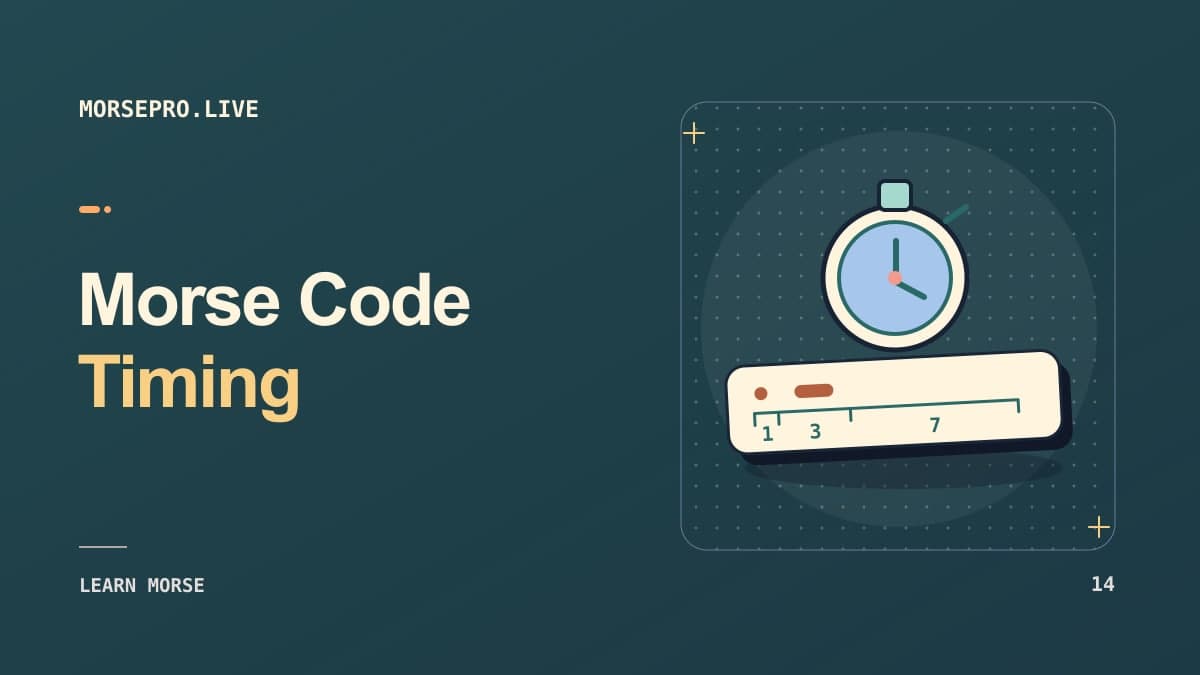
Quick answer: Use a short flash for each Morse dot and a longer flash for each dash. In standard timing, a dash lasts three times as long as a dot. Leave one dot unit between marks in a letter, three units between ordinary letters and seven units between words. SOS is three short flashes, three long flashes and three short flashes, sent as a special continuous distress pattern.
A flashlight is a simple way to demonstrate that Morse code is not limited to beeping radios. As long as a receiver can distinguish short and long signals and their pauses, light can communicate the same coded letters. But signaling at a distance adds practical problems: the beam must be visible, the timing must be steady and the receiver has to know what they are watching.
Morse Code Flashlight Basics: Dots, Dashes and Pauses
Start with a light that can be switched on and off deliberately. Decide on a base dot length that you can repeat comfortably. If one dot lasts one count, a dash lasts three counts. Separate marks within a single letter by one count of darkness, wait three counts between letters and seven counts between words. These ratios are more important than any particular absolute length.
For a first exercise, send E (.), then T (-), then A (.-). Ask the listener to distinguish them without seeing the written code. Once the contrasts are clear, try HI (.... ..) or HELLO (.... . .-.. .-.. ---). The Morse Code Alphabet provides more characters as you improve.
Try not to rely on a generic strobe mode. A rapid, regular strobe is useful for visibility but normally does not convey dots, dashes and letter gaps. To transmit an intentional message, you need specific timing. A hand-controlled light or a purpose-built Morse flasher can provide that control.
How to Signal SOS with a Flashlight
The recognizable SOS sequence is short-short-short, long-long-long, short-short-short. Written as a visual reminder, it is ... --- ..., but formal SOS is a single continuous distress prosign without ordinary letter-length pauses between its three groups. After the complete sequence, leave a noticeable gap before repeating it.
If you are practicing, pick a safe location and tell everyone it is a demonstration. In a genuine emergency, use emergency calling, radio distress equipment or other established rescue methods whenever available. A flashing light may help attract attention, but its effectiveness depends on visibility, distance, conditions and whether another person notices it.
Government emergency-signaling guidance stresses the value of being visible and using available reliable means to attract help. That can include a whistle, reflective surface or light, alongside official emergency contact methods. Do not delay a clear distress call in order to perform Morse perfectly, and do not use a hobby demonstration to create a false alarm.
How Long Should a Morse Flash Last?
For slow practice, imagine a dot lasting about half a second and a dash lasting about one and a half seconds. A different comfortable base duration is acceptable as long as you preserve the 1:3 contrast. Use an equal short off-gap between individual elements of one letter, then a larger pause before moving to the next letter.
At very fast speeds, manual flashlight switching becomes difficult. Some people find it easier to keep the flashlight on and briefly cover the beam to create the off-periods. Whatever method you use, the receiver must see crisp edges between flashes. A slowly fading light can smear together adjacent dots and dashes, especially from far away.
The Morse Code Keyer offers a useful analogy: each key press represents a signal being active, and each release represents silence. Practice keying before transferring the rhythm to a light. This makes it easier to avoid an accidental extra flash when you change letters.
Send HELLO or a Custom Message with Light
HELLO is a good second challenge after SOS because it demonstrates ordinary letter boundaries. Send H (....), then E (.), then L (.-..) twice, then O (---). If the observer hears or sees the groups without the pauses, the word becomes hard to reconstruct. Give the receiver a chart at first so they can check each pattern as it arrives.
You can write a custom sentence in the Morse Code Translator and rehearse one word at a time. Choose short messages for your earliest attempts: YES, NO, HI and OK are easier to recognize than a paragraph. If the message needs a complicated explanation before the recipient can decode it, shorten it or provide a visible cue.
To make the activity interactive, have two participants take turns. One flashes a word and the other writes down the dots and dashes, leaving spaces according to the observed gaps. Then compare the received transcription with the original. You will quickly discover whether mistakes come from signal length, spacing or an incorrect memorized letter.
Flashlight Morse Code Safety and Practical Limits
Never point a bright light at drivers, pilots, or people operating machinery for recreational practice. Avoid prolonged flashing in a way that could affect anyone with photosensitivity. Use a printed or audible alternative when needed, and follow local rules for emergency signaling and use of lights.
Weather and geography affect visibility. Fog, rain, daylight, obstacles and background lighting can all make a flash harder to distinguish. A handheld torch is not a substitute for safety equipment, location sharing, an emergency beacon or a working communications plan. In a real rescue situation, positioning yourself safely and using the most dependable available communication channel matter more than demonstrating Morse literacy.
Also consider battery life. Constantly practicing a long coded message may waste power that could be valuable later. Keep nonessential messages short and bring spare power where appropriate. For planned educational activities, work in a well-lit safe environment even if that reduces the dramatic effect of a distant flashlight signal.
Troubleshooting Flashlight Morse Messages
If a receiver sees a jumble, ask them to check whether the short and long flashes are really different enough. The difference should be obvious, not subtle. Next, inspect the gap between letters. A clear sequence can still decode incorrectly if the receiver thinks one letter ended earlier than it did.
Another issue is reading direction. In a written pattern, symbols are arranged left to right; in a timed light signal, the receiver needs to know when to start paying attention. Begin with a short demonstration or agreed cue rather than launching into a complex sentence without warning. Repeat the exact message when practicing, not a slightly different version each time.
Use the Morse Code Practice page to recognize sounds and lengths before working with a flashlight. Understanding sound rhythms often transfers well to visual signals because the code's temporal structure remains the same.
A Two-Person Flashlight Signaling Exercise
Agree on a safe indoor or outdoor location where the signals will be visible without distracting anybody else. Begin with a single E flash, then a T flash, and ask the observer to identify which is which. Next send A and N, which have the same two kinds of marks in opposite order. Only after those work reliably should you attempt HI or another short word.
Have the observer write the received code rather than guessing an intended sentence. Compare their transcription with your original and discuss whether an error came from mark duration, an unclear pause or the direction of the light. This turns a simple flashlight experiment into a useful lesson about transmitting information accurately. Always stop if the light becomes uncomfortable to watch.
Frequently Asked Questions
What is Morse code with a flashlight?
It is Morse transmitted through timed flashes rather than sound or radio. Short flashes represent dots and longer flashes represent dashes.
How do you flash SOS?
Send three short flashes, three long flashes and three short flashes, then pause and repeat when appropriate. Seek official emergency assistance whenever possible.
Is three flashes the same as SOS?
No. Three repeated flashes may attract attention, but the complete SOS Morse pattern contains nine signals with both short and long elements.
Can a phone flashlight send Morse code?
A controllable device light may be used, but browser and device permissions vary. A screen-based light display can sometimes serve as a demonstration instead.
Is flashlight Morse useful during the day?
Bright sunlight often makes a flashlight difficult to see. Other approved signaling methods may be more appropriate depending on the situation.
How can I practice without a flashlight?
Use the Morse Code Generator for sound or the Morse Code Keyer for manual timing practice.
To prepare a short message, translate the text on MorsePro.live, review the code and rehearse it safely.