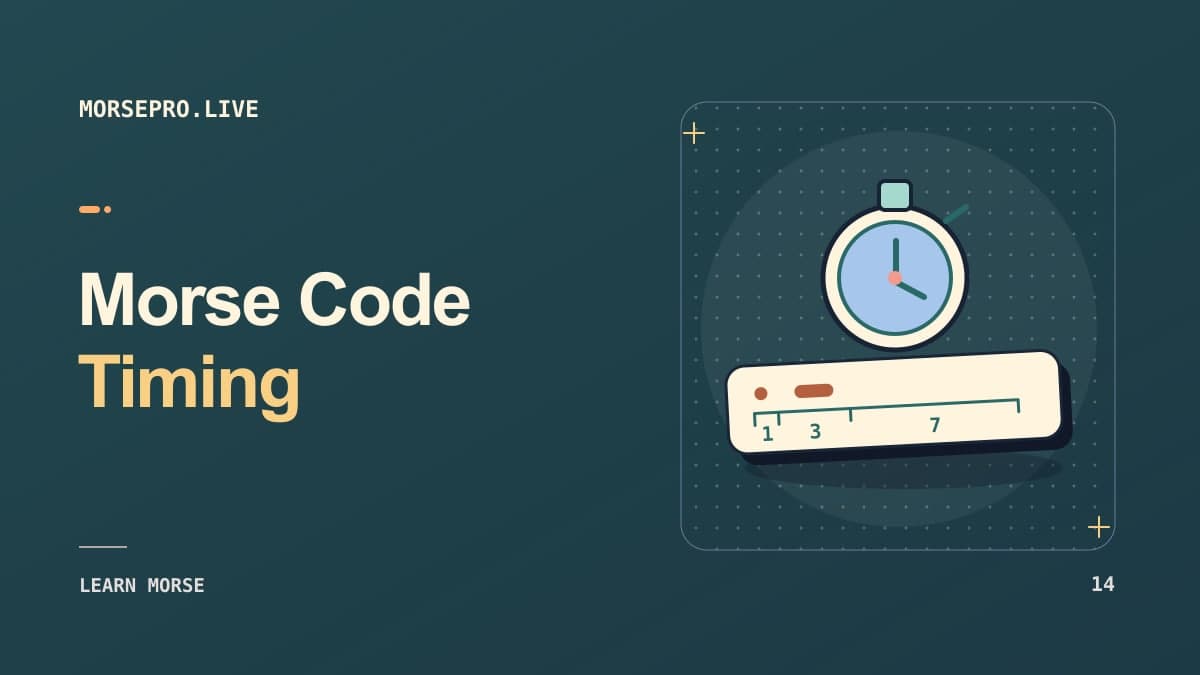
Quick answer: Standard International Morse timing uses one unit for a dot, three units for a dash, one unit of silence between marks within a character, three units between letters and seven units between words. This is often called the 1–3–7 timing principle, although the one-unit gap inside characters is also essential.
Morse code is not simply an alphabet of printed dots and dashes. It is a system of timed events, including periods when nothing is transmitted. Two people can send the same letter shapes yet produce different results if the gaps change. Understanding timing explains why audio decoders, practice tools and telegraph keyers devote so much attention to speed and spacing.
Morse Code Timing: The One, Three and Seven Rule
Choose the dot as the basic time unit. In a character such as A (.-), the dot is one unit long, followed by one unit of silence, then a three-unit dash. Between A and the next letter, use a total three-unit silence after A's final mark. Between words, use a seven-unit silence. Do not add these pauses twice; the relevant gap is the full silence between signal elements.
| Morse component | Duration in dot units |
|---|---|
| Dot | 1 |
| Dash | 3 |
| Gap between marks of one letter | 1 |
| Gap between two letters | 3 |
| Gap between words | 7 |
These are relative durations rather than one fixed number of milliseconds. At higher words per minute, every base unit becomes shorter, while the ratios stay the same. The Morse Code Keyer is useful for getting a feel for those relationships during manual sending.
How Long Is a Dot or Dash at Different Speeds?
A common standard for measuring Morse speed uses the word PARIS as a 50-unit reference, including its usual trailing word gap. At conventional timing, the dot duration in seconds is approximately 1.2 divided by the speed in words per minute. At 20 WPM, that produces a dot of about 0.06 seconds, or 60 milliseconds; a dash is about 180 milliseconds.
| Speed | Dot duration | Dash duration |
|---|---|---|
| 5 WPM | 240 ms | 720 ms |
| 10 WPM | 120 ms | 360 ms |
| 15 WPM | 80 ms | 240 ms |
| 20 WPM | 60 ms | 180 ms |
| 25 WPM | 48 ms | 144 ms |
These figures illustrate standard character timing. A real message can take a different amount of time depending on the number of dots, dashes and gaps. A five-letter word containing many long marks may take longer than another five-letter word. WPM provides a useful common reference rather than a promise that every word has identical duration.
Morse Code Spacing Between Letters and Words
Spaces are not optional decoration. Suppose you transmit E (.) and T (-). With an ordinary three-unit letter pause, the receiver hears two characters, ET. If you use only a one-unit gap, the receiver may hear A (.-) instead. The same dots and dashes now form a different message because their spacing changed.
Word boundaries create another important distinction. The phrase HI THERE needs a seven-unit word gap after HI, not the three-unit separation normally used between individual letters. In written web notation, this is often represented as .... .. / - .... . .-. .. The slash is a convenient printed cue for a pause, but the actual radio signal contains silence, not a slash character.
A good practice exercise is to listen to two versions of the same phrase: one with correct gaps and one with gaps that are too short. Use the Morse Code Practice tool to learn the audible difference. Most beginning mistakes involve boundaries as much as individual mark lengths.
What Is WPM in Morse Code?
Words per minute measures transmission speed using a standardized reference word rather than the changing lengths of everyday words. Morse practice commonly uses PARIS because it defines a consistent 50-unit standard sequence. The resulting speed allows learners and operators to compare settings across software and practice recordings.
At 20 WPM, a 60-millisecond dot is fast enough that many learners stop counting individual elements and begin recognizing whole character rhythms. At lower speeds, such as 5 WPM, individual marks are long enough to count, but that approach can become a habit that is difficult to sustain when audio grows faster.
Do not confuse the pitch of a Morse tone with WPM. Pitch determines whether a beep sounds high or low; WPM determines how quickly the coded signals are sent. A generator may offer both settings independently, so increasing tone frequency will not automatically increase speed.
Farnsworth Morse Code Spacing Explained
Farnsworth timing keeps the individual characters at a relatively brisk speed while extending the spaces between characters or words. For example, a learner might hear characters shaped at 20 WPM but have enough extra silence to achieve a much slower overall message rate. This encourages recognition of complete sound shapes without making the internal dots and dashes unnaturally slow.
Why does that matter? When every element is played extremely slowly, beginners may count each dot instead of recognizing a letter's rhythm. At normal speed, that counting strategy becomes impractical. Farnsworth training aims to preserve the character sound while leaving more time for the learner to process what was heard.
This method should not be confused with random or inconsistent gaps. The extra spacing is deliberate and controlled. The American Radio Relay League has published technical guidance on Farnsworth timing, and serious training tools often let users set character speed separately from effective text speed. Explore this in the Learn Morse Code lessons if you are moving from printed charts to receiving by ear.
How to Practice Correct Morse Timing with a Keyer
Start with simple letters: E is one short press, T one long press, and A short then long. Use a steady dot unit and leave the intended gap inside each character. Next practice pairs such as ET and A, comparing how their pauses change what the receiver hears. This exercise is more informative than simply trying to key a long word quickly.
Move to short words after individual letter pairs sound consistent. Record your sending and listen back, or use a keyer that displays estimated timing and decoded characters. If your dashes are too short, slow down. If characters merge, increase the gaps rather than overcorrecting the marks themselves. Small improvements in consistency make a disproportionate difference in intelligibility.
For audio file experiments, create a clean recording with the Morse Code Generator and compare it with your own keying. A waveform can reveal whether long marks really last about three times as long as short marks, and whether the intended gaps are actually present.
SOS Timing and Other Special Signals
The emergency SOS signal is commonly displayed as ... --- ..., but its formal transmission is a continuous nine-element prosign. The gaps between the three visual groups are not ordinary letter-length pauses. This makes SOS an instructive exception to a simple rule about every written space indicating a letter boundary.
Other procedural signals can also be sent as run-together combinations. Their context and conventions should be learned separately rather than inferred from an ordinary phrase translator. When in doubt, identify whether the material is a written word, an abbreviation sent as distinct letters, or a prosign sent as one special pattern.
The governing reference is ITU-R Recommendation M.1677-1. It is more authoritative for International Morse than an unverified timing graphic found on social media.
Frequently Asked Questions
What is the standard Morse code timing rule?
A dot is one unit, a dash three, an internal gap one, a letter gap three, and a word gap seven dot units.
What is the dot duration at 20 WPM?
Using the standard PARIS reference, one dot lasts approximately 60 milliseconds and a dash 180 milliseconds.
What is Farnsworth spacing?
It sends individual character patterns relatively quickly but adds longer gaps so a learner has more processing time at a slower overall text speed.
Is Morse code pitch the same as speed?
No. Pitch controls tone frequency, while speed controls signal and gap durations.
Why do my Morse letters merge?
Your letter boundaries may be too short. Preserve three-unit gaps between ordinary characters and longer word gaps.
Where can I practice timing?
Use the Morse Code Keyer to send patterns and Morse Code Practice to improve recognition.
When you are comfortable with spacing, try composing a new message using the online Morse translator.