Quick answer: To read Morse code, separate the message into letter groups, then match each group of dots and dashes to its character. A space normally separates letters in a written message, while / often indicates a word break. For audio, listen for the rhythm of each character and the longer silences between letters and words.
Decoding Morse can feel intimidating when you first see a line of punctuation marks. The trick is to stop treating it as one enormous string. Morse is built from smaller, repeatable character patterns. Once you recognize a few letters and learn to notice spaces, longer messages become a series of manageable steps rather than a mystery.
How to Read Morse Code Written as Dots and Dashes
Begin with a clearly separated example, such as .... . .-.. .-.. ---. Read .... as H, . as E, .-.. as L, the repeated .-.. as another L, and --- as O. The result is HELLO. This process works because each group is treated as a complete letter rather than a fragment of a larger continuous line.
Use a Morse alphabet chart when you encounter a pattern you do not recognize. Keep your place by marking the letter groups as you go. A pencil or an on-screen selection can help prevent you from losing a gap. If you are unsure about a pattern, write a question mark next to that group and continue with the rest rather than repeatedly rereading the entire line.
A word such as HELLO WORLD is written .... . .-.. .-.. --- / .-- --- .-. .-.. -... The slash is not part of either word; it marks the longer word separation in this common text notation. Once you decode HELLO, start again after the slash and work through WORLD. The method scales naturally to longer sentences.
Morse Code Reading Chart: Important Starter Letters
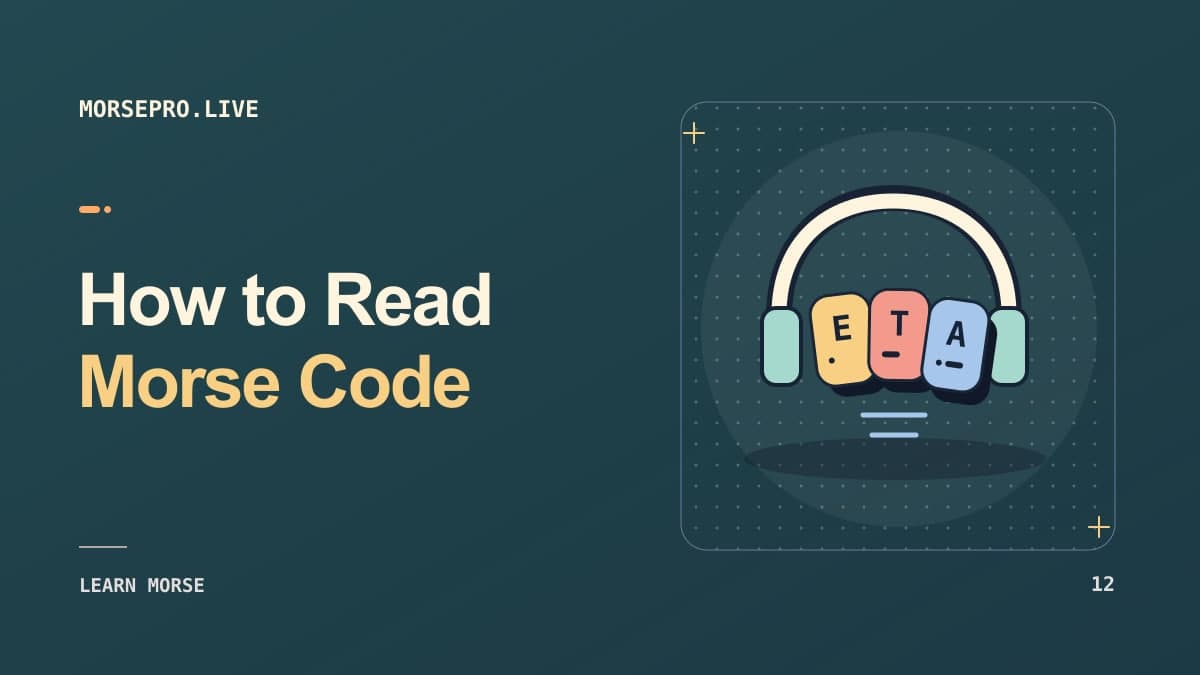
Some letters are easy to recognize because of their simple structure. Start with E (.) and T (-), then add A (.-) and N (-.). Next learn I (..) and M (--). With only those six letters, you already have enough symbols to recognize several short examples and compare sound patterns.
| Letter | Morse | Memory cue |
|---|---|---|
| E | . | One dot |
| T | - | One dash |
| A | .- | Short then long |
| N | -. | Long then short |
| I | .. | Two dots |
| M | -- | Two dashes |
| S | ... | Three dots |
| O | --- | Three dashes |
This table is a learning starter, not a replacement for the complete International Morse reference. Your goal is to recognize patterns as whole units. Constantly counting dots may help during the first minutes, but listening fluency usually improves when each character has a distinctive sound shape in your mind.
How to Read Morse Code by Ear
Audio Morse contains no visible spaces. The receiver must infer boundaries from silence. Dots are short sounds, dashes about three times as long, and ordinary gaps between letters are longer than the gaps inside a character. Listen to the overall rhythm instead of trying to write every dot as a separate mark while the message keeps moving.
Begin with isolated letters played at a comfortable character speed. Compare A (dit-dah) and N (dah-dit), then S (three short sounds) and O (three long sounds). These pairs teach how order and duration create different letters. Once you can identify them reliably, add mixed groups and short words.
Use the Morse Code Practice exercises for listening, then check your guesses with a Morse-to-text decoder. The decoder is a verification tool: it can reveal the intended result for a written pattern, but it does not replace the skill of recognizing sounds. Practice both independently to understand where your mistakes originate.
The Morse Tree Method for Visual Decoding
A Morse tree is a visual learning aid organized around dot and dash choices. You begin at the root and follow one branch for a dot and the other for a dash. The endpoint identifies a letter. This can make unfamiliar patterns easier to navigate while you are learning, because the route mirrors the ordered sequence of marks.
For instance, E and T occupy the first level because each requires only one mark. A and N extend those branches with the opposite mark. Longer codes continue farther down the tree. The tree is a useful reference for decoding written patterns but should not become a permanent crutch for rapid audio receiving.
Try comparing a tree with an ordinary alphabet list. The alphabet list is easy for quick lookup when you know which letter you want to send; the tree is useful when you have a series of unknown marks and need to discover their character. Eventually, repeated practice helps you recognize the character without tracing branches each time.
Morse Code Spacing: How to Find the Words
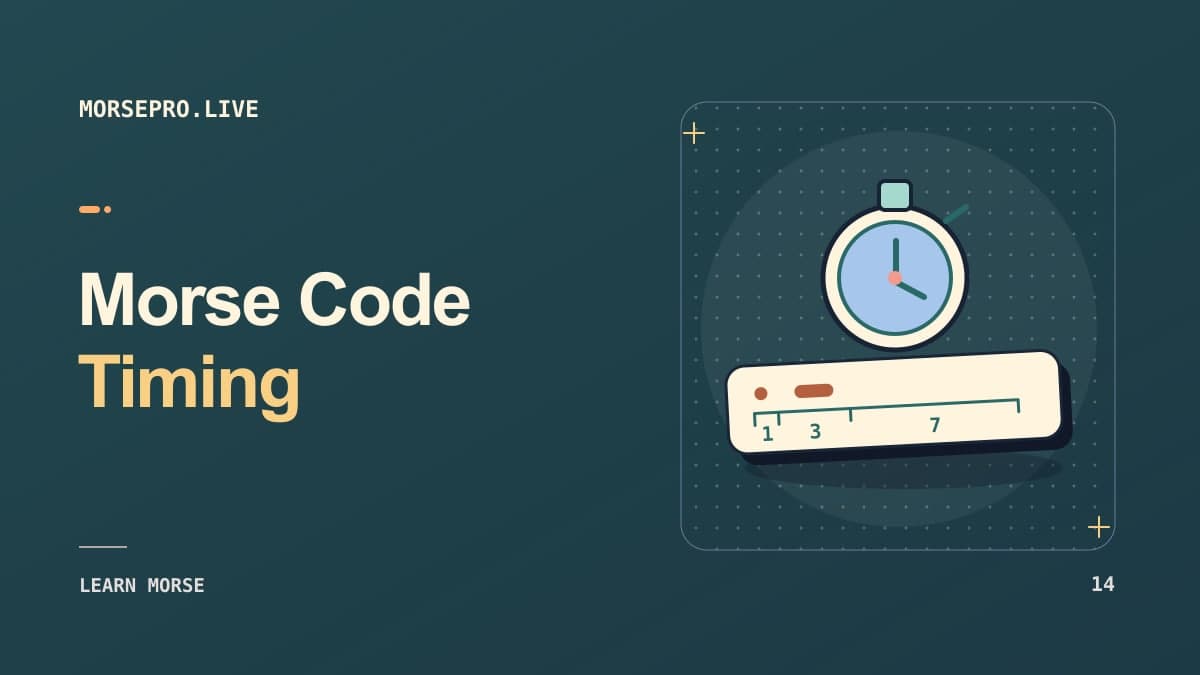
Correct Morse timing uses one unit of silence between marks inside a character, three between letters and seven between words. In written examples, those distinctions are usually simplified into uninterrupted dot-dash groups, spaces and slashes. This formatting is convenient, but it can hide how essential silence is to real Morse.
If a message arrives as ......, there may be several plausible ways to split the dots into characters. A decoder cannot reliably reconstruct the original intended letters without additional clues. If you receive an ambiguous written string, ask the sender for separators or listen to the original audio recording, where the gaps may still be preserved.
Good readers pay attention to empty intervals as much as to marks. During practice, leave generous whitespace between your transcribed words, and do not rush to guess a sentence based only on context. A plausible word is not proof that the code was actually transmitted correctly.
A Simple Seven-Day Morse Reading Plan
On day one, learn E, T, A and N. Day two introduces I, M, S and O. Day three adds short words and familiar phrases; day four practices receiving by ear with the same characters. Day five introduces several new letters and number patterns. Day six focuses on listening to mixed groups, and day seven reviews errors with a short quiz.
Treat that timetable as a flexible practice suggestion, not a guarantee that everyone will learn at the same speed. Five to ten focused minutes can be more useful than a long session filled with guessing. If you can already read written Morse but struggle with audio, spend more time on hearing character rhythms and less time memorizing the printed chart.
Keep a small notebook of commonly confused characters. A and N, S and H, and B and D can create errors because they contain similar marks with different lengths or order. Use the Learn Morse Code lessons for a structured progression and the Practice page for additional drills.
Common Mistakes When Decoding Morse Code
The first mistake is merging neighboring letters. The second is assuming every short sound is identical even when its duration is unusually long. The third is fixing missed letters too aggressively. When receiving live audio, the next character may arrive while you are still trying to correct the previous one; write a placeholder and continue.
Another mistake is confusing punctuation marks in printed notation with the actual punctuation being encoded. A forward slash between code groups typically marks a word gap, but a literal slash character has its own Morse pattern. Read the notation conventions on the page or tool you are using before interpreting an unusual sequence.
Finally, avoid treating Morse as a language with direct word symbols. Most ordinary messages spell words letter by letter. Abbreviations and prosigns exist in specialized contexts, but they are additions to the basic procedure, not a replacement for learning letters.
Frequently Asked Questions
What is the easiest way to read Morse code?
Start with clearly spaced written examples and a reference chart. Learn a few short patterns before attempting full messages.
Can I decode Morse code by ear?
Yes. Practice listening to the rhythms of letters and the pauses between them, gradually increasing difficulty.
What does a slash mean in Morse text?
In many online tools, it marks a word boundary. It is a display convention, not an extra spoken character.
How do I know where one letter ends?
Written code normally includes spaces, while transmitted Morse uses a three-dot-unit gap between ordinary letters.
Can a translator help me learn?
Yes. Use the Morse-to-text tool to verify your transcription, then practice decoding without it.
Do Morse letters change between English words?
No. A given International Morse letter has the same pattern wherever it appears, although specialized prosigns and other code systems have separate rules.
Try decoding HELLO yourself, then compare it with the MorsePro.live translator.