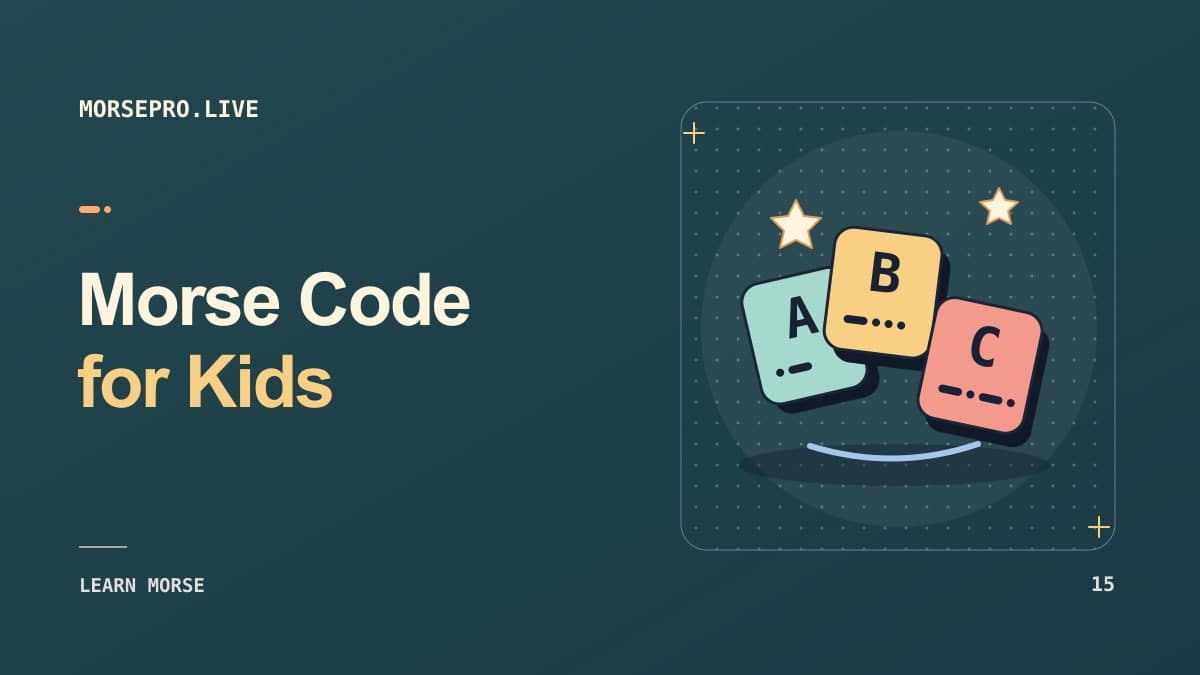
Quick answer: Morse code is a fun way for children to learn that messages can be represented by patterns instead of ordinary letters. Start with E (.), T (-) and short names, then try decoding worksheets, making bead bracelets or sending short words with a flashlight or buzzer under adult supervision.
Morse code combines history, simple logic and hands-on activity. Children can see a message transform into marks, then decode it back into words. Unlike a purely abstract code exercise, Morse can be heard, tapped and displayed as light. That makes it useful for mixed-age activities, school lessons, science clubs and family afternoons.
Morse Code for Kids: Explain Dots and Dashes Simply
Tell children that a dot stands for a short signal and a dash for a longer one. Show how E uses one dot and T one dash. Then demonstrate A (.-) and N (-.), which use the same two marks in different orders. That small comparison proves that order matters. Give learners a simple chart and let them invent short questions for classmates to decode.
Avoid beginning with all 26 letters at once. A handful of reliable patterns creates early success, especially for young students. Kids who recognize E, T, A and N can already play simple matching games, and older learners may enjoy adding I, M, S and O. The Morse Code Alphabet provides a complete reference when the activity grows.
Explain that Morse is not a secret language with special words. It is a way to write ordinary letters as patterns, much like assigning every character a different sequence. The message stays the same after decoding. That is an age-appropriate introduction to encoding, computer data and communication systems.
Easy Morse Code Activities for Kids
The simplest activity is a matching game. Write several large letter cards and matching Morse cards, then have children find the pairs. Another activity is a decoding relay: teams receive short coded clues and race to write the letters correctly, with a chart available for anyone who needs help.
A treasure hunt works particularly well. Each clue can spell a familiar place, such as DESK, BOOK or DOOR. Place clues only in safe, accessible locations and avoid sending children into isolated or hazardous areas. The American Radio Relay League describes Morse scavenger hunts as a practical youth education activity, demonstrating how the subject can combine problem-solving with movement and teamwork.
For a quieter classroom, invite learners to encode their first names. They can draw the marks in colored pencils or place small paper shapes beneath each letter. The activity is personal, repeatable and easy to adjust for different ages. A complete alphabet reference keeps the emphasis on discovering patterns instead of memorizing everything immediately.
Printable Morse Code Worksheets for Beginners
A good worksheet should begin with a small reference chart and several short examples. One section can ask students to decode individual letters, another to decode a three-letter word, and a third to encode their own name. Add blank lines so children can write both the code and the decoded text, not merely circle a multiple-choice answer.
For a simple challenge, print .... .. and ask students what it means. The answer is HI. Next print ... --- ... as the letters S, O and S and discuss the familiar distress sequence. Explain carefully that the formal SOS signal is sent as a continuous pattern, even though the spaced letters make it easier to teach. The distinction introduces the role of timing and conventions.
More advanced worksheets can include punctuation, numbers and short sentences. Avoid making every example a mystery so difficult that learners lose interest. Include an answer key or an optional checking method. The Morse Code to Text Translator can help teachers verify their examples before printing.
Make a Morse Code Bracelet as a STEM Activity
Bead bracelets combine a code chart with physical patterns. Use one bead shape or color for dots, another for dashes and small spacer beads between letters. Children translate a short name or word, lay out its pattern, then thread the beads in order. The National Inventors Hall of Fame has published a STEM activity based on this same general idea.
Plan the materials for the age group. Small beads, scissors and cords need appropriate supervision, especially with younger children. Paper bead templates or large cardboard shapes can provide a safer alternative where small parts are unsuitable. A useful teaching moment is asking why separators are needed: without them, the bracelet's encoded letters may blend into one unreadable line.
Invite students to swap completed patterns and decode one another's messages. If a bracelet does not decode correctly, treat it as a debugging task. Where did a dot become a dash? Which spacer is missing? This connects craft work with the same error-checking habits used in computing and engineering.
Morse Code Games with Sound and Tapping
A teacher can play a single letter using a buzzer or computer sound and ask children to choose its matching card. Start with clearly different patterns, such as E and T, before introducing more similar letters. Keep the volume comfortable and offer visual alternatives for learners who cannot access the sound easily.
Tapping games are another choice. One child sends a short dot or a longer dash using a tabletop, while others transcribe what they hear. If physical knocking is too noisy for a classroom, an on-screen Morse Code Keyer can present the same idea with visual feedback. Adult supervision can help ensure the game stays collaborative rather than competitive.
Use the Morse Code Practice page for short recognition sessions. A good exercise is to play three characters, ask learners to write the result and then reveal the answer. Encourage accuracy and curiosity rather than rewarding speed alone, because rushed signaling tends to remove important spaces.
Morse Code History for School Projects
Morse code grew from nineteenth-century efforts to send messages over electrical telegraph lines. Samuel Morse is a well-known figure, but Alfred Vail and other collaborators made important contributions to working instruments and the code. In 1844 a Washington-to-Baltimore demonstration showed how a message could travel electrically over a long distance.
Children may enjoy building a timeline: early telegraphs, the development of International Morse, radio communication and today's coding projects. Compare an old telegraph sounder with a modern browser tool. Both use the same basic idea of representing information through deliberate signals, even though the equipment looks completely different.
The National Army Museum offers an educational Morse challenge, and the ARRL provides kid-focused Morse resources. These examples can help teachers plan a lesson with a strong historical or STEM connection instead of treating Morse as a novelty.
A Simple 30-Minute Morse Code Lesson Plan
Spend the first five minutes introducing dots and dashes. Use the next ten minutes to decode simple characters with a chart. Let students spend another ten minutes encoding names or building a paper bracelet design. Finish with a five-minute quiz in which every learner checks one message and explains why the spaces matter.
Adapt the pace freely. Younger children may need more time for handwriting, while older students may prefer an audio challenge or a small electronics experiment. Provide a written alternative to flashing lights, and avoid activities that could disturb anyone sensitive to repetitive visual or auditory signals.
For homework, ask learners to write one short positive message for someone else. The recipient can decode it with the chart or the free Morse Code Translator. A meaningful use helps the lesson stick better than a list of isolated patterns.
Frequently Asked Questions
Is Morse code easy for kids?
Basic dots-and-dashes exercises are approachable when introduced with just a few letters and plenty of practice.
What is the best first Morse activity?
Encoding a first name or decoding HI is simple, memorable and easy to check.
Can children make a Morse code bracelet?
Yes, using age-appropriate materials and supervision. Keep bead patterns and letter spacers clearly distinguishable.
What should a Morse worksheet include?
A reference chart, short examples, space to record answers and an answer key make a useful starter worksheet.
Does Morse code teach programming?
It introduces encoding, sequences, timing and checking, which are relevant computing concepts, but it is not a programming language by itself.
Where can students practice online?
Try the Morse alphabet, practice tool and online translator together.
Use a short, personalized message to turn the lesson into a friendly decoding challenge.