Quick answer: SOS in Morse code is ...---...: three dots, three dashes, three dots, transmitted as a single continuous distress signal. It is often displayed as ... --- ... to make its three groups easy to see, but the formal distress prosign has no ordinary letter-length pauses between the S, O and S groups.
SOS is familiar enough to appear in movies, classroom posters and phone wallpapers. Yet knowing the nine marks is only half of understanding it. The silence between marks, the difference between a short signal and a long one, and the context in which you send it are what turn a pattern into an understandable call for help. This guide covers the sound, the history and practical ways to recognize SOS rather than merely memorize its appearance.
What Is SOS in Morse Code?
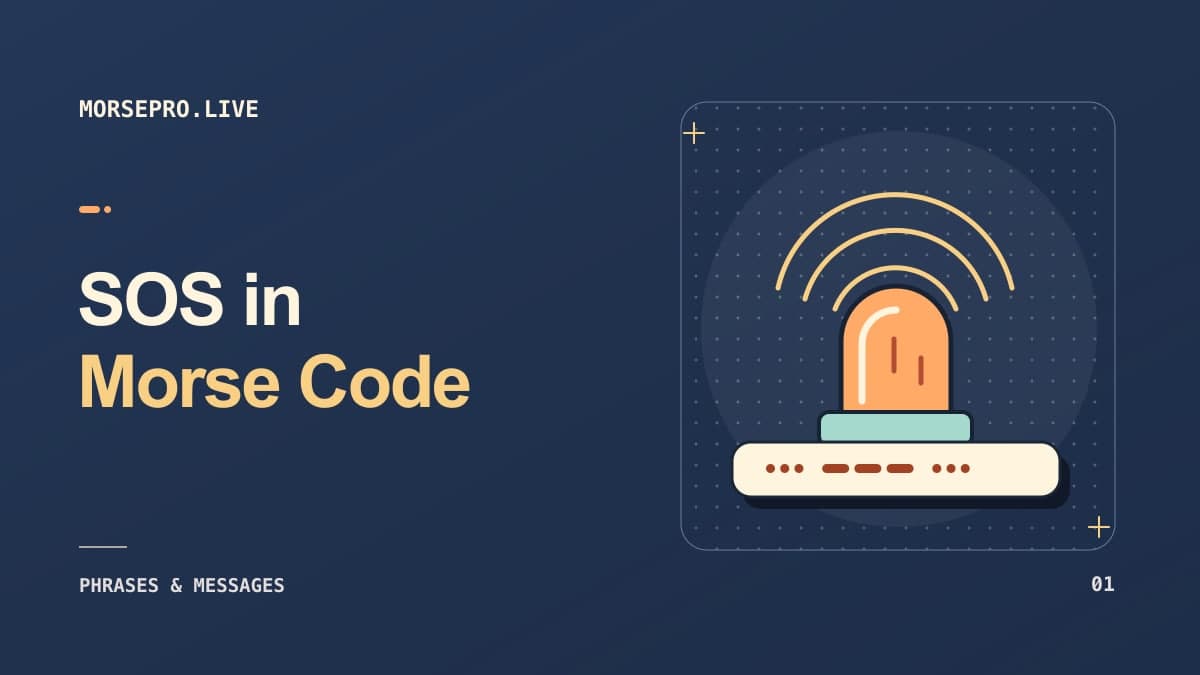
The visual pattern has three sections: ... for S, --- for O, and ... for S again. The middle section consists of long signals; the outside sections consist of short ones. Those letters are a convenient way to write and remember the sequence, not three separate words. A normal written phrase such as SOS HELP has conventional letter and word boundaries, whereas the formal SOS signal is sent as a continuous nine-element group.
Think of the rhythm as short-short-short, long-long-long, short-short-short. You can hear the difference with the Morse Code Generator, which can produce audible marks. A familiar melody is not required, and changing the pitch will not change the message: the relative lengths and pauses carry the information.
| Section | Marks | Meaning of the marks |
|---|---|---|
| First | ... | Three short signals |
| Middle | --- | Three long signals |
| Last | ... | Three short signals |
Does SOS Mean Save Our Souls or Save Our Ship?
Neither phrase is the original meaning. The familiar explanations Save Our Souls and Save Our Ship are retrospective memory aids, sometimes called backronyms. SOS was adopted as a distinctive radiotelegraph distress signal rather than an abbreviation made from an English sentence. That distinction matters because international distress communication should work for people who do not share a spoken language.
The signal emerged from early wireless-telegraph standardization. An international conference in Berlin in 1906 included this distress sequence in its rules, which took effect in 1908. As maritime wireless systems expanded, a clear, recognizable pattern offered a more consistent alternative to several competing distress calls. People still say the three letters aloud, but the communication value lies in the code itself.
There is another myth worth correcting: SOS did not begin with the sinking of the Titanic. The Titanic's operators later used both CQD and SOS, but the international SOS convention was already in place. Understanding that timeline helps separate a memorable historical event from the development of the signaling standard.
How to Send SOS in Morse Code with Sound
Start with a comfortable dot length. Suppose a dot lasts half a second. A dash then lasts about a second and a half. Keep the gaps between individual marks short and consistent; after completing all nine marks, take a noticeably longer pause before repeating the entire signal. In a formal continuous SOS pattern, do not insert ordinary letter gaps between its three visual sections.
Try the following practice routine:
- Say the pattern aloud using the words dit and dah.
- Tap three short sounds on a tabletop, then make three clearly longer sounds, then three short sounds again.
- Replay the sequence at a steady pace instead of speeding up toward the end.
- Record or generate the sound and listen without looking at the notation.
- Ask a friend to identify which group is the distress pattern and which is ordinary speech-like tapping.
A signal is easier to recognize when the long sounds are consistently longer than the short sounds. If you are learning Morse rather than sending an actual distress call, visit the Morse Code Practice page for listening exercises. In an emergency, use established emergency channels and contact local emergency services whenever possible; Morse should not replace a more reliable means of asking for help.
How to Flash SOS Using a Light
A flashlight, lamp, or illuminated screen can carry the same short-long rhythm. Switch the light on briefly three times, then for three longer periods, then briefly three times again. Aim toward someone who could see the signal; a beautifully timed pattern is not useful if the light is hidden behind a wall or pointing away from the observer.
Short flashes should be visibly different from long ones, with crisp off-periods between individual signals. A flashlight can be easier to operate by covering and uncovering its beam rather than repeatedly pressing a small power switch. Avoid directing bright beams into drivers' eyes or creating distractions near traffic. Practice in a safe environment, not in a way that could be mistaken for a genuine emergency.
For non-emergency demonstrations, the Morse Code Keyer helps you understand press-and-release timing. The same idea works with a buzzer or drum: short events represent dots and sustained events represent dashes. Flashing displays can affect people sensitive to flashing light, so check accessibility needs before using rapid visual demonstrations.
SOS Timing, Letter Gaps and Common Mistakes
International Morse timing starts with one dot unit. A dash lasts three units, the silence inside a standard character lasts one, the pause between ordinary letters lasts three, and a word gap lasts seven. SOS is a special run-together signal, so its groups should not be separated like independent letters during formal sending.
A common mistake is to treat every cluster of three as equivalent. Three identical flashes repeated with a pause may attract attention, but it is not the same as transmitting the precise nine-mark SOS sequence. Another mistake is making dashes only slightly longer than dots; in low light or noisy audio, a receiver can then mistake one for the other.
Some software displays ... --- ... because adding spaces makes the sequence readable on a web page. That is acceptable as an explanatory notation. In actual SOS transmission, the continuity is important. If a tool plays the sequence with normal letter gaps, it is demonstrating the letters S-O-S rather than reproducing the formal prosign exactly. Test both styles so the distinction is clear.
When Is SOS Used Today?
SOS remains an internationally recognized distress pattern and a useful part of signaling literacy. However, modern maritime distress communications rely on radio and satellite systems, including the Global Maritime Distress and Safety System, rather than routine manual Morse distress traffic. A modern sailor should understand their emergency equipment and safety procedures instead of assuming that a flashlight alone is enough.
SOS also appears in popular culture, escape-room puzzles, school lessons and amateur-radio discussions. For a classroom demonstration, invite students to encode an everyday phrase beside SOS. This comparison makes it obvious why ordinary messages need letter boundaries and why the emergency pattern is distinctive. The Morse Code Alphabet gives a reliable reference for other letters, digits and punctuation.
Frequently Asked Questions
What is the exact SOS Morse code pattern?
Three short, three long and three short marks: ...---.... It is commonly printed as ... --- ... for readability. The formal distress signal is one continuous group.
Is SOS an abbreviation for Save Our Souls?
No. The phrase is a mnemonic created after the signal became established. It can help you remember the letters but is not the historical origin.
How do you send SOS on a flashlight?
Make three short flashes, three noticeably longer flashes and three short flashes; pause, then repeat if appropriate. Use safe signaling practices and seek help through official emergency means if they are available.
Can you use Morse code without a radio?
Yes. Short and long signals can be represented with light, sound, touch or written symbols, provided both people agree on the timing and spacing.
Is the Titanic the reason SOS exists?
No. SOS was standardized before the Titanic sank in 1912. Its operators used it alongside CQD during the disaster.
Next step: To compose your own non-emergency message, enter it into the free Morse Code Translator and play its audio before experimenting with longer patterns.