Quick answer: I LOVE YOU in International Morse code is .. / .-.. --- ...- . / -.-- --- ..-. Single spaces separate letters, while the slash represents the longer pause between words. There is no dedicated symbol meaning the entire sentence; each of its eight letters has its own code.
A few dots and dashes can make an ordinary message feel like a personal puzzle. Unlike an emoji or a conventional greeting, a Morse message asks the recipient to take part: to listen, decode, trace or reveal the words. You do not need radio equipment or a special course to get started. A well-spaced copy of the pattern and a little practice are enough.
I Love You in Morse Code: Copy the Full Pattern
Here is the phrase with each word kept separate:
.. / .-.. --- ...- . / -.-- --- ..-
Read the first group .. as I; the middle four groups spell LOVE; the last three spell YOU. Written Morse has no uppercase/lowercase distinction, so the translation remains the same whether you typed "I love you" or "I LOVE YOU." Decorative Unicode dots and long dashes can represent the same marks, but basic periods and hyphens are easiest to paste into an online decoder.
For a card, write the exact three groups with a clear word separator. For a tiny engraving, you might replace the slash with a noticeably larger space, but never remove the boundaries entirely. Translate text to Morse code if you want to personalize the message with a name, anniversary date or additional words.
Morse Code for I Love You, Letter by Letter
| Letter | Morse | Sound pattern |
|---|---|---|
| I | .. | dit-dit |
| L | .-.. | dit-dah-dit-dit |
| O | --- | dah-dah-dah |
| V | ...- | dit-dit-dit-dah |
| E | . | dit |
| Y | -.-- | dah-dit-dah-dah |
| O | --- | dah-dah-dah |
| U | ..- | dit-dit-dah |
The repeated O appears in both LOVE and YOU, which makes the phrase easier to learn. Notice that E consists of just one dot, while Y starts with a dash and contains two more dashes. If you misplace a dot inside a letter, you may accidentally spell a different character. Check the alphabet chart whenever a pattern looks uncertain.
How to Say I Love You in Morse Code with Sound
A dot is called a dit and a dash a dah. A long sound should last around three times as long as a short sound; the pitch need not change. Start with I, which uses two short sounds. Pause between ordinary letters and make the pause between words longer. Then play LOVE as four separate patterns before moving to YOU.
Try listening in three passes. First, listen while reading the letters. Next, cover the dots-and-dashes text and follow the words only. Finally, play the recording without visual help and write down what you think you heard. This is an excellent introduction to audio recognition because the sentence is meaningful and short enough to repeat.
The Morse Code Generator is the appropriate place to customize an audible version, select speed and export a sound file. For a more tactile experience, tap the sequence using the Morse Code Keyer. Whichever method you choose, the correct word and letter gaps are more important than making every beep sound attractive.
How to Tap, Blink or Flash I Love You
You can turn the phrase into physical signals without changing its code. With tapping, use a brief tap for a dot and a longer press or sound for a dash. With light, make short flashes and long flashes using the same ratio. With eye movements, deliberate short and long closures could serve as a private convention, but interpreting them requires practice and agreement between participants.
The phrase is longer than SOS and has three words, so trying to improvise it from memory usually leads to missing letters. Practice the words separately, then rehearse them in order. If the other person has never learned Morse, include a small decoding key. A secret message is enjoyable only when the recipient has some way to discover what it says.
Use blinking and flashlight signaling thoughtfully. Avoid using rapid flashes around people sensitive to light, and do not mistake playful eye-blinking exercises for dependable emergency communication or accessibility technology. For a safer introduction, send the written code as a note and let the recipient listen to its sound afterward.
Morse Code Love Messages for Cards and Gifts
A handwritten note is an easy place to start: put the coded phrase on the outside and the translation inside. For an anniversary print, place the message beneath a date, keeping each character group readable. In a framed piece, you can let the pattern become part of a line drawing or a minimalist border.
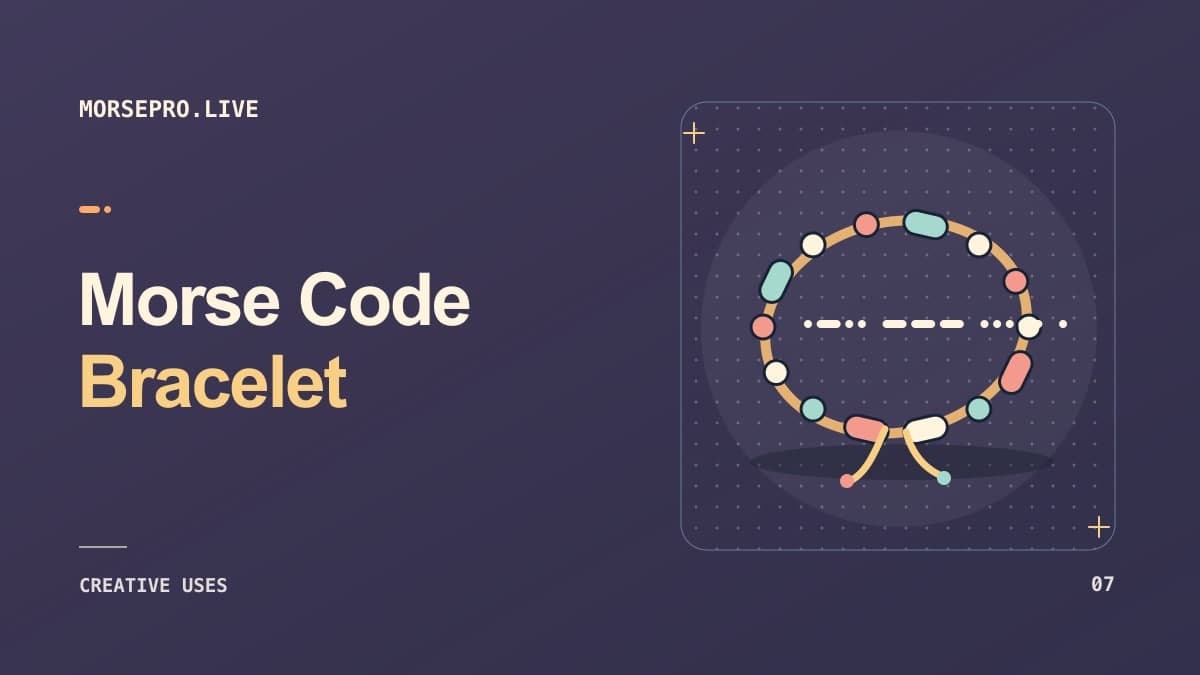
For jewelry, separate short and long marks with bead shapes, colors or engraving lengths. Choose contrasting spacers between letters, and make the gap between words obvious. Before ordering a bracelet or engraving, copy the actual pattern into the Morse Code to Text Translator and verify that it decodes to the intended sentence. A quick reverse check can prevent an expensive error.
An important design constraint is length. "I LOVE YOU" has eight encoded letters; very small rings may not have enough space to maintain clear boundaries. Instead of squeezing the entire phrase into an unreadable band, consider LOVE alone, initials, or a shorter meaningful word. Simplicity makes the hidden message easier to recognize.
Is 143 the Same as I Love You in Morse Code?
No. The number 143 is a different shorthand: one letter in I, four in LOVE and three in YOU. It is not a Morse code sign for the sentence. If you encode the literal digits 1, 4 and 3, you get .---- ....- ...--, which represents "143" rather than the words themselves.
Similarly, ILY is an abbreviation written with three letters; converting ILY creates a shorter Morse message, but it is not identical to spelling the full phrase. If privacy or brevity matters, decide whether the recipient should decode a shorthand or a complete sentence. Both can be fun, but they answer different questions.
Common Problems with Romantic Morse Messages
Missing word gaps is the most common difficulty. Without boundaries, the receiver cannot reliably determine where one letter ends and the next begins. Mixing dash lengths is another problem in drawings; a narrow dash may look like a dot, particularly at small sizes. If you copy Unicode characters from a decorative font, check that the characters remain readable after pasting into the app you intend to use.
Avoid making exaggerated claims that Morse is encryption. Anyone with an alphabet chart or translator can decode it. Morse can hide a message from casual readers, but it does not provide real confidentiality. If your message contains private information, use a genuinely secure channel rather than relying on the dots and dashes.
A Simple Two-Person Morse Love Message Activity
For a memorable surprise, prepare two versions of the same note. Give the recipient the Morse string first, then provide a small reference chart or translator link if they do not recognize the code. Ask them to write the decoded words on a blank card. Once they solve the message, play the audio version so they can hear its rhythm as well as read it. This creates a shared activity without requiring expensive equipment.
If you are making the activity for somebody who reads differently or cannot use sound, present the pattern visually with large, high-contrast marks and clearly labeled letter groups. The surprise should be accessible rather than dependent on a particular sensory ability. Keep the intended wording respectful, easy to decode and free of avoidable spelling ambiguities.
Frequently Asked Questions
What is the copy-and-paste Morse code for I love you?
Use .. / .-.. --- ...- . / -.-- --- ..-. The slashes identify spaces between the three words and are not spoken as additional Morse letters.
How many letters are in I love you in Morse?
Eight letters: I, L, O, V, E, Y, O and U. The words are transmitted one character at a time.
Can I make an I love you Morse code bracelet?
Yes. Use distinct dot and dash beads, clear letter separators and a longer word gap. Check the finished layout with a decoder before making it permanent.
Is a heart symbol part of International Morse?
No. A heart is not one of the standard alphabet characters; it can be a decorative element outside the encoded sequence.
Can I download an audio message?
Generate the phrase with the Morse Code Generator and use its available export controls. Review the playback before sharing it.
For a completely personal phrase, start at the MorsePro.live translator, then copy and verify your result.