Quick answer: American Morse and International Morse are related but distinct signaling systems. American Morse developed for nineteenth-century landline telegraphy and used additional timing distinctions, while International Morse became a more uniform system widely adopted for wireless communication. A modern online Morse translator normally uses International Morse unless it explicitly offers another mode.
It is easy to assume that every dot-and-dash message from any era can be decoded using the same chart. That assumption can lead to incorrect historical interpretations. The telegraph industry developed over time, and the code used on older American wires did not always match the alphabet and timing that radio hobbyists learn today. Understanding the difference helps when reading antique material or building a historically accurate project.
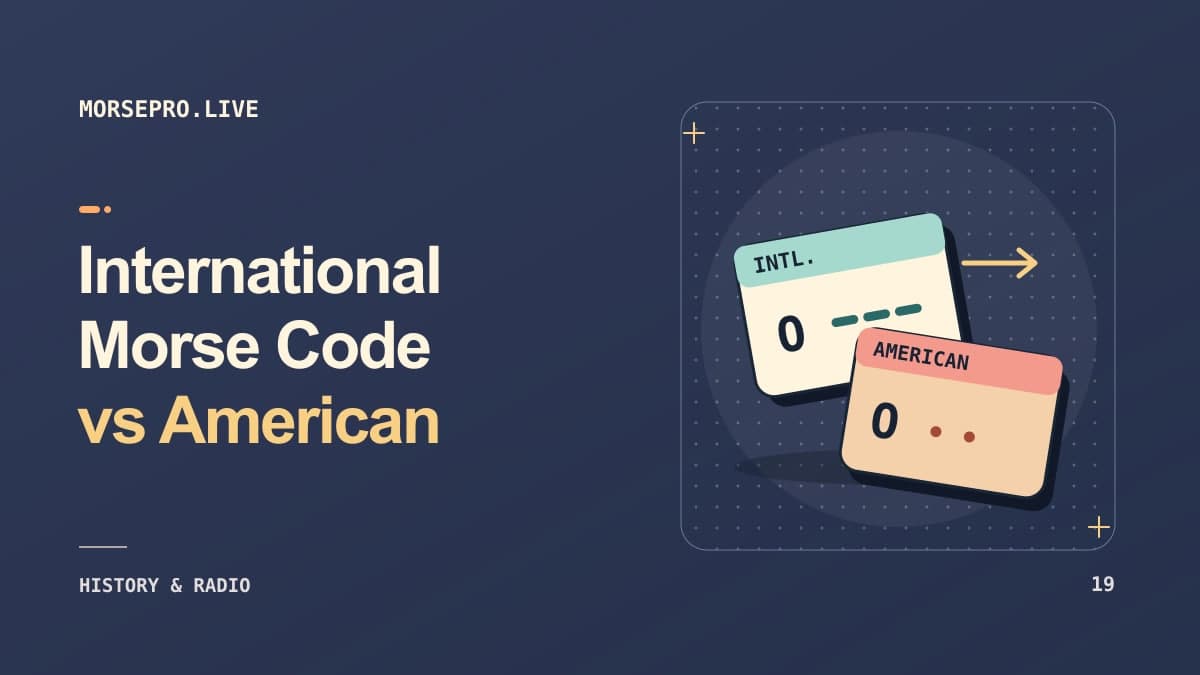
American Morse Code vs International Morse Code
American Morse, sometimes called Railroad Morse, was associated with early telegraph lines in the United States. It contained conventions such as different dash lengths and internal spaces in certain characters. International Morse used a more standardized set of relative durations that was better suited to communication across different countries and eventually to radio operation.
The familiar International pattern uses short elements, long elements and defined gaps. A dot lasts one timing unit, a dash three, the ordinary gap between elements inside a character one, the gap between letters three and the gap between words seven. Historic American practice was more complex, and a simple International Morse lookup table cannot necessarily interpret an American telegraph recording or manuscript.
| Feature | American Morse | International Morse |
|---|---|---|
| Historical setting | U.S. landline telegraphy | International and radio communication |
| Timing conventions | Includes additional distinctions | Standard dot, dash and gap ratios |
| Letter patterns | Some differ from modern code | Common modern reference alphabet |
| Typical learning resource | Historical telegraph materials | Online translators and CW training |
| Best for | Authentic period research | Most contemporary Morse uses |
This comparison is about code systems, not a claim that one person could never learn both. Telegraph operators sometimes needed both alphabets when messages crossed networks that used different conventions.
Where Did American Morse Code Come From?
Samuel Morse, Alfred Vail and colleagues developed early telegraph equipment and code methods during the 1830s and 1840s. The familiar 1844 Washington-to-Baltimore demonstration helped make electrical telegraphy visible to the public. The code used in that period evolved alongside instruments designed to record or sound electrical signal changes along a wire.
American telegraph operators became highly skilled at hearing patterns produced by sounders and converting them directly into text. They developed professional conventions suited to their equipment and networks. That living practice is historically important even though today's public often encounters only the International alphabet.
The U.S. National Park Service's telegraph history describes how the original American code differed from European versions and why operators needed knowledge of both systems as international traffic expanded. This is a helpful starting point for research based on primary-era equipment rather than an ahistorical computer-generated chart.
Why Did International Morse Code Develop?
As telegraph networks expanded across borders, incompatible signaling conventions became a practical problem. International Morse emerged during nineteenth-century standardization efforts, with an important European code introduced in 1851. The goal was to make communication more consistent across different languages, networks and operators.
Later radio communication further increased the value of shared conventions. A vessel or radio station needed to be understood by other stations that might not use the same landline telegraph culture. International Morse eventually became the system most familiar to amateur-radio operators and users of online translation tools.
It is useful to distinguish adoption from invention. International Morse did not appear out of nowhere or immediately replace every existing system. American Morse continued in some settings for many years, while international practices gradually developed and spread. The overlap is part of the story, not a contradiction.
Are the Morse Code Letters the Same in Both Systems?
Some basic patterns are similar, but others differ, and the timing rules are not interchangeable. Therefore, recognizing a familiar letter in an old message does not prove that the entire message follows the International standard. The most cautious approach is to identify the era, equipment and code tradition before trying to decode a historical source.
For modern International Morse, E is ., T is -, A is .-, and N is -.. These familiar beginner examples help explain the modern system. However, a complete historical American Morse table includes special conventions that need their own reference. Do not translate an antique sounder recording solely by reading its marks as though every dash had a modern International duration.
The Morse Code Alphabet on MorsePro.live uses International Morse for ordinary translation and learning. That is the appropriate reference for most contemporary educational, browser and amateur-radio examples, but it should be labeled honestly rather than presented as a universal key to all telegraph codes in history.
How Did Telegraph Sounders Differ from Radio Beeps?
A landline telegraph sounder produces mechanical clicks as an electrical circuit opens and closes. Operators learned to hear the timing of those clicks and the resulting rhythm. Modern radio Morse is often experienced as an audible tone created by receiving a keyed radio carrier. The transmission medium therefore changes what the human receiver hears, even when the communication relies on timed signals.
American Morse professionals became practiced at the distinctive sounder rhythms of their system. International Morse is generally taught using dits and dahs represented by clear audio tones or printed dots and dashes. If you are recreating an old telegraph station for a museum display, the equipment sound and the exact code standard both matter.
A modern Morse Code Generator can help demonstrate International Morse tones. It should not be described as an authentic nineteenth-century American sounder simulation unless it explicitly recreates those historical code and equipment behaviors.
Which Morse Code Should Beginners Learn?
International Morse is the practical choice for most beginners. It is the basis of widely available alphabet charts, current CW learning materials and typical web translators. If your goal is to hear basic Morse, send a short coded message or begin amateur-radio listening, learn that standard first.
Choose American Morse when you have a specific historical goal, such as interpreting period telegraph records, studying railroad communications or restoring an old sounder. In that case, find a specialist reference and authentic training materials for the relevant code variant. Trying to force older patterns into a modern translation app may result in inaccurate results.
The Learn Morse Code lessons can help you build the modern International alphabet systematically. The Morse Code Practice page provides rhythm recognition, which remains useful for learning how code works even when historical systems differ.
Are SOS and Other Prosigns Identical in Every Code?
Do not assume so. The internationally recognized SOS distress sequence is associated with International Morse: three short signals, three long signals and three short signals sent together. It became important in maritime radio during a period when international standardization mattered. Older American landline Morse conventions predate that modern distress practice and differ in important ways.
The letters S, O and S are an easy mnemonic for SOS, but the formal pattern is a special continuous signal. When reading early documents, ask what kind of traffic was being transmitted. A railway operator's nineteenth-century message and an early twentieth-century ship's wireless distress call may share the idea of Morse while following different operating standards.
The ITU International Morse Recommendation is the appropriate reference for modern International Morse signs and timing. Historical documents require additional specialized references.
Frequently Asked Questions
Is American Morse the original Morse code?
It is closely associated with early U.S. landline telegraphy and differs from the later international system commonly used today.
Is American Morse still the standard?
No. International Morse is the familiar standard for most modern web translators and amateur-radio CW learning.
Why are the codes different?
They developed for different operating contexts and underwent separate standardization, producing differences in letter patterns and timing.
Can a modern translator decode American Morse?
Only if it explicitly supports that code system. A typical International Morse converter may produce errors with historic American code.
Which code does MorsePro.live use?
The site's core translator and alphabet use standard International Morse.
Which one should I learn first?
For general use, learn International Morse. Study American Morse separately if your goal is historical telegraph research.
Use the free Morse Code Translator to experiment with International Morse letters and phrases.