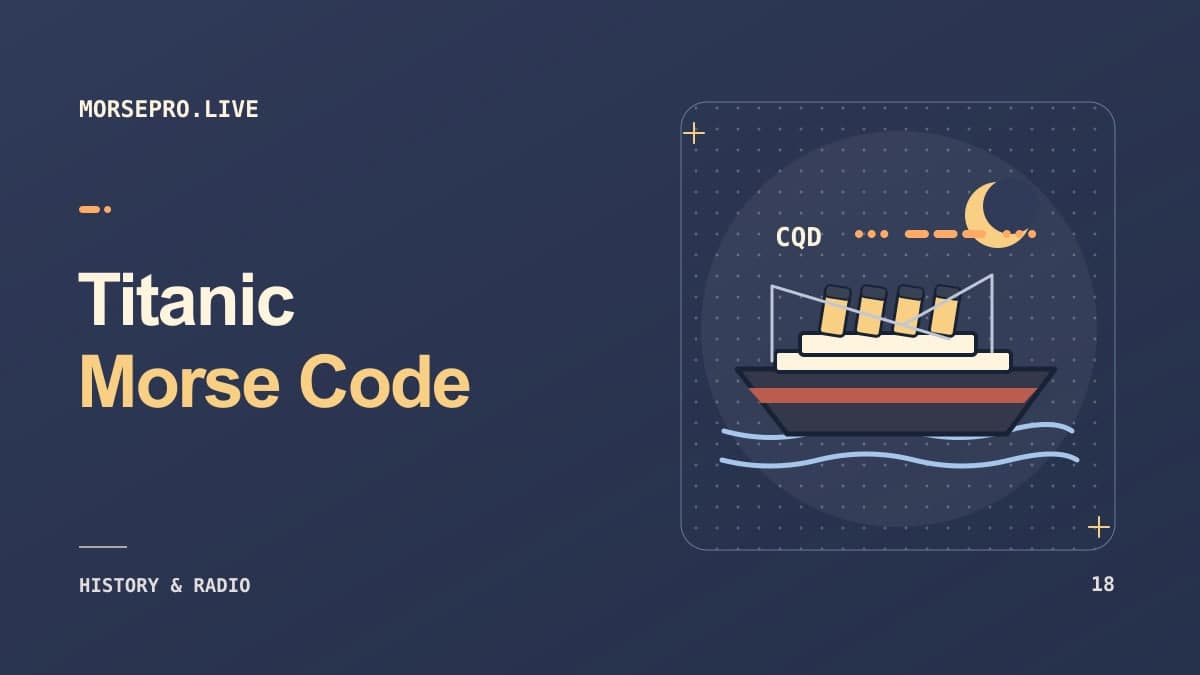
Quick answer: During the sinking of RMS Titanic in April 1912, wireless operators used both CQD and SOS to request help. CQD was an established distress call associated with the Marconi wireless service, while SOS had been adopted as an international distress signal before the disaster. The two signals were not interchangeable acronyms for the same English words.
The Titanic tragedy is closely linked to Morse code in popular memory, but the details are frequently simplified. A film may show one operator sending a single frantic SOS, whereas historical records describe exchanges with multiple ships, changing conditions and repeated messages carrying positions and requests for assistance. The technology itself mattered because wireless messages could reach other vessels beyond visual range.
Titanic Morse Code: Why Wireless Messages Mattered
Titanic had wireless telegraph equipment and operators who could send messages through radio rather than through a physical cable. The ship's radio call sign was MGY. After the ship struck an iceberg on the night of April 14–15, 1912, wireless distress traffic became one of the primary ways to ask other vessels for help.
A distress message was more than three letters. Operators also had to identify the ship, describe the situation and transmit a position so rescuers could navigate toward it. Other stations replied, repeated information or coordinated their own movements. This illustrates why Morse radio communication demanded trained operators: receiving a call was only the first step in an unfolding exchange.
The British Wreck Commissioner's inquiry preserved records of messages sent and received in connection with Titanic. Those records are a valuable historical source, although they include material relayed by different ships and recorded at different times. A careful account separates confirmed documented traffic from dramatic quotations reconstructed in later retellings.
CQD vs. SOS: What Was the Difference?
CQD was a wireless distress call used in Marconi practice before SOS became the worldwide standard. The prefix CQ called all stations, while D indicated distress in the convention. Some popular explanations expand CQD into elaborate phrases, but the operational meaning was a general call announcing an emergency.
SOS was standardized through international radiotelegraph rules adopted in the early twentieth century. In International Morse it is three dots, three dashes and three dots: ...---... as a continuous distress signal. It does not originally mean "Save Our Souls" or "Save Our Ship." Those memorable English expressions came afterward.
The two methods coexisted for a period because operators and stations did not immediately abandon familiar procedures. Titanic's operators transmitted both CQD and SOS during the emergency. That combination reflects a transition in wireless practice rather than evidence that the operators were confused about what distress meant.
Who Sent Titanic’s Wireless Distress Calls?
Jack Phillips and Harold Bride were the two wireless operators aboard Titanic. They worked with the ship's communications system under extremely difficult conditions as the situation worsened. Phillips did not survive the sinking, while Bride survived and later provided testimony about the events.
Their work involved sending distress signals, positions and other messages and listening for responses from ships in range. The radio room was part of a larger rescue effort that also depended on captains, crews, lifeboats and the actions of other vessels. Avoid reducing the tragedy to a single heroic beep; the communication story is valuable precisely because so many decisions and responses mattered.
PBS's American Experience explains the transition from CQD to SOS and notes the use of both calls aboard Titanic. Historical investigations also provide message tables, enabling researchers to examine what stations reported receiving without assuming every later anecdote is accurate.
What Did Titanic Send in Morse Code?
The familiar pattern for SOS is ...---..., sent continuously rather than as three ordinary letter groups. CQD, by contrast, can be represented as three separate letters: C (-.-.), Q (--.-) and D (-..). A full wireless call used additional procedural words, identifiers and information about the ship's position.
For example, DE is a conventional radio abbreviation meaning "from" or "this is" in a station identification context. Operators used such conventions to make communications concise and recognizable. But a list of coded letters does not fully capture the urgency of a distress exchange involving multiple ships and competing signals.
You can enter the ordinary letters CQD or SOS into the Morse Code Translator to hear their patterns, while remembering that formal SOS is a continuous prosign rather than three normally spaced letters. The Morse Code Generator can demonstrate standard character sounds, but it is not a reconstruction of Titanic's actual historical transmission audio.
When Were Titanic’s Last Distress Messages Sent?
Many historical summaries place the first major distress call shortly after midnight on April 15 and the final transmissions near the time the ship lost electrical power and sank. However, precise accounts vary because surviving reports were recorded by different stations, sometimes using different time conventions or later recollections.
Rather than quoting one dramatic sentence as Titanic's undisputed last message, consult primary material. The British Wreck Commissioner's report on wireless messages provides a sequence of reported communications. A United States defense historical publication also summarizes distress calls and responses. Those sources are more informative than an unattributed screenshot claiming to show the final words.
The key point is that Titanic continued seeking help while other vessels were attempting to respond. Messages included ship identifiers, distress calls and location information. The eventual arrival of Carpathia to recover survivors is inseparable from that broader system of maritime wireless communication.
Did Titanic Invent or Popularize SOS?
Titanic did not invent the signal. The 1906 international conference and subsequent implementation preceded the disaster. Titanic did, however, contribute to public awareness of wireless distress communication and the importance of dependable radio operations at sea. The disaster highlighted the consequences of gaps in equipment, watches, procedures and coordination.
Subsequent developments in maritime radio sought to improve safety and standardize operation. More recent systems such as GMDSS use satellite and terrestrial technologies rather than relying on routine manual Morse calls. The history is therefore a story of changing communications practice, from early wireless signaling toward increasingly integrated safety systems.
For a student project, make a timeline that distinguishes the standardization of SOS, Titanic's 1912 emergency and later modernization of maritime radio. This prevents the common misunderstanding that SOS began on the Titanic simply because that incident is so famous.
How to Learn the Titanic-Era Signals Today
Begin by learning the International Morse characters for C, Q, D and the letters S and O. Compare CQD as three letters with SOS as a continuous distress pattern. Listen to their sound shapes and notice the differences in spacing. The exercise shows how conventions and timing can change the interpretation of an apparently simple string.
Next read a few lines from the historical wireless message table. Identify call signs and standard abbreviations such as DE, then use a Morse alphabet chart to understand how the letters themselves were sent. Not every surviving document includes the exact acoustic timing of each historic transmission, so do not present generated modern audio as an authentic archival recording.
The best research combines technical context with historical humility. We can explain the code accurately while acknowledging that certain details of the final minutes are reconstructed from incomplete and differently reported accounts.
Frequently Asked Questions
Did Titanic send SOS or CQD?
Both. Titanic's wireless operators used CQD and the newer international SOS distress signal.
What does CQD mean?
It was a distress call in Marconi wireless practice, based on the general call CQ and a distress indication.
Was SOS invented because of Titanic?
No. The international SOS signal existed before the 1912 disaster.
Who sent Titanic's Morse messages?
Wireless operators Jack Phillips and Harold Bride handled the ship's radio communications during the emergency.
What was Titanic's last Morse message?
Specific claims about the final message should be checked against contemporary records and inquiry testimony; summaries vary in exact details.
Can I hear a recreation of Titanic's Morse code?
You can generate the relevant letters with the Morse Code Generator, but that is modern demonstration audio, not an original Titanic recording.
To understand the signals behind the historical story, explore the online Morse translator.