Quick answer: Samuel F. B. Morse is the person most commonly credited with Morse code, but the system was created and improved through collaboration. Alfred Vail played an important role in developing instruments and an alphabetic dot-and-dash code, while Leonard Gale and other researchers contributed to telegraph engineering. The later International Morse code is not identical to the original American system.
The story is often summarized as one inventor discovering a way to communicate with dots and dashes. The full account is more interesting. A new technology needed electrical equipment, a workable signaling alphabet, long-distance wiring, public demonstrations and business support. Each stage depended on more than one person's effort.
Who Invented Morse Code?
Samuel Finley Breese Morse was an American artist who became interested in electrical telegraphy during the 1830s. His name became attached to the communication system that emerged from the work. As the Smithsonian's National Museum of American History explains, Morse developed early electrical telegraph experiments after discussions about electricity during his return voyage from Europe in 1832.
However, calling Morse the sole creator of every feature of the code oversimplifies the record. Alfred Vail helped refine Morse's apparatus and developed an alphabetic code that improved on earlier numeric approaches. Leonard Gale contributed knowledge that helped extend successful signaling over greater distances. A full history should recognize those collaborators without dismissing Morse's central organizing role.
If you encounter a school quiz that asks "Who invented Morse code?", Samuel Morse is the expected short answer. For a historical essay, add Vail and Gale and explain how the original code evolved. The more precise answer depends on whether the question refers to the telegraph apparatus, the original American code or later International Morse.
Samuel Morse Before the Telegraph
Morse was a painter before he became famous for telegraphy. His artistic training makes the career change especially striking: he moved from representing ideas through images to developing a means of sending information electrically across great distances. Interest in electricity and rapid communication was growing during the nineteenth century, when scientists and inventors in several countries were experimenting with signaling methods.
In the early 1830s, Morse began sketching and exploring ways electrical impulses might be sent along wires. His work developed through experiments and partnerships over subsequent years. The Smithsonian describes early transmitter and receiver designs, improvements in relays and the contributions of knowledgeable collaborators. Telegraphy became a practical system through sustained iteration rather than a single dramatic flash of inspiration.
Remember that the historical inventor was also a complex public figure, not simply a technical hero. Museum scholarship discusses his controversial political positions alongside his achievements. A responsible account can recognize the importance of telegraphic communication without pretending every view held by its prominent inventor deserves admiration.
Alfred Vail’s Contribution to Morse Code
Alfred Vail is a major figure in the story. After seeing Morse demonstrate a telegraph in 1837, Vail joined the work as a partner and contributed technical skill, financial support and equipment improvements. Smithsonian archival material describes refinements to the registering apparatus and a simpler alphabetic code that helped make messages easier to interpret.
An early numeric system required translating signal patterns into numbers and then consulting a code book. An alphabetic dot-and-dash approach reduced that extra step. Vail's contributions helped make signaling faster and more practical. The precise division of credit has been discussed by historians, but treating him as merely someone who watched Morse work would be inaccurate.
Leonard Gale also belongs in the narrative. His knowledge of electromagnetic research helped Morse improve the reliability of signals over longer wires. Engineering innovations are often collective because working products require insights from different specialties, and the early telegraph is a clear example.
The First Famous Morse Telegraph Message in 1844
On May 24, 1844, a famous public demonstration sent the message "What hath God wrought?" from Washington, D.C., to Baltimore, Maryland. The phrase became a symbol of the telegraph's potential because it demonstrated electrical communication across a substantial distance. Alfred Vail was involved at the receiving end.
It is important not to label this the first telegraph message ever transmitted by anyone. Earlier telegraph systems and experimental messages already existed. Its significance was as a widely noted demonstration of Morse's system and a turning point in public attention and commercial development in the United States.
For a classroom project, place 1844 on a timeline beside later milestones: expansion of telegraph networks, development of international code conventions and radio signaling. That progression helps explain why a code associated with wires eventually became recognizable through sound and wireless transmissions.
How American Morse Became International Morse Code
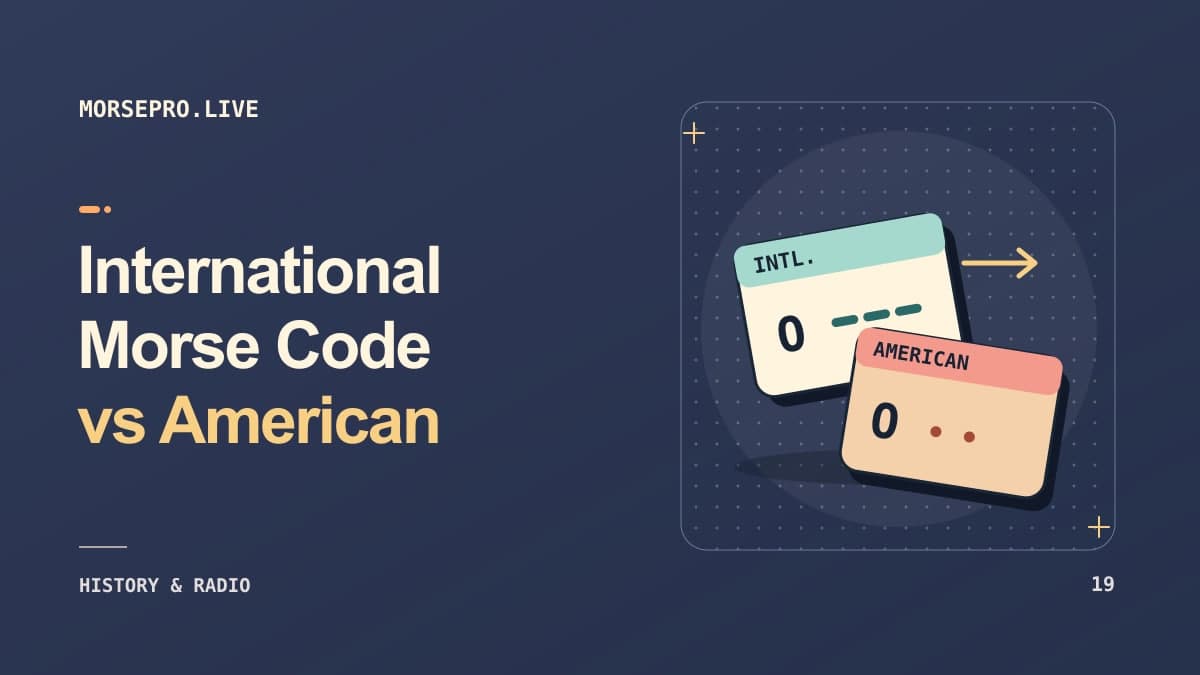
The code used by many nineteenth-century American telegraph operators was not identical to the International Morse most people learn today. American Morse included different signal conventions and more complex timing distinctions. As communication expanded across national borders, a more standardized international system developed, with an important European version introduced during the nineteenth century.
The U.S. National Park Service notes that American operators continued using their system for many years while international and transatlantic communication required familiarity with different conventions. This is why interpreting an old telegraph manuscript may require a different reference than decoding a modern online International Morse example.
MorsePro.live tools primarily target the standard International Morse alphabet. If you type HELLO into the Morse Code Translator, you receive a modern International Morse pattern, not an automatic recreation of the older American telegraph alphabet. For historical documents, establish which system the source used before trying to decode it.
Morse Code and the Growth of Communication Networks
Telegraph wires changed the relationship between distance and information. News, commercial instructions and personal messages could travel far more quickly than physical letters carried by vehicles or ships. Telegraph networks also introduced new institutions, skilled operators and standardized practices for routing messages.
Later, radio made it possible to transmit coded signals without a continuous wire between stations. Morse became particularly associated with wireless operators, ships, military communications and amateur radio. Modern digital networks largely replaced manual Morse in routine commercial service, but the code's simplicity continues to make it useful for demonstrations and hobby communication.
The Morse Code Alphabet and Learn Morse Code pages let you explore the signal system itself. If you are curious how a written message sounds, use the Morse Code Generator to hear the same basic concept through a modern browser.
What Should Students Remember About Morse’s Invention?
Remember three points. First, the invention grew from 1830s telegraph experiments and became widely recognized after the 1844 Washington-to-Baltimore demonstration. Second, Morse's collaborators, especially Alfred Vail and Leonard Gale, deserve acknowledgment. Third, the International Morse used today evolved from earlier systems and should not be confused with every historical telegraph convention.
The best historical research uses institutions that preserve instruments, original records and the work of contemporary historians. The Smithsonian National Museum of American History and Smithsonian Institution Archives offer complementary accounts of Morse and Vail's roles.
A short school presentation can include a photograph of a telegraph key, a timeline, the famous 1844 message and a modern Morse example. That demonstrates how the technology worked and why it changed communication rather than reducing the subject to a memorized name and date.
Frequently Asked Questions
Who invented Morse code first?
Samuel Morse is most commonly credited, but collaborators including Alfred Vail made substantial contributions to the early code and telegraph apparatus.
What did Alfred Vail do?
Vail helped improve telegraph equipment and developed a more practical alphabetic dot-and-dash system.
When was Morse code invented?
The early system developed through the 1830s and 1840s. Later International Morse conventions emerged during the nineteenth century.
What was Morse’s famous first message?
"What hath God wrought?" was the message sent in the well-known 1844 Washington-to-Baltimore demonstration.
Is original American Morse the same as International Morse?
No. The older landline system has different code and timing conventions from modern International Morse.
Where can I hear Morse code now?
Use the Morse Code Generator to produce modern International Morse audio and compare it with historical descriptions.
Explore the main MorsePro.live translator to see how ordinary letters become coded signals today.