Quick answer: Morse code operators use abbreviations and procedural signals to communicate efficiently. CQ is a general call, DE means "from" or "this is" in station identification, QTH concerns location, QSL acknowledges receipt, and 73 is a conventional sign-off meaning best regards. Some abbreviations are sent as separate letters, while prosigns are run-together signals with special procedural meaning.
Morse is a character code, but real radio communication includes much more than spelling everyday sentences letter by letter. Operators have developed compact conventions to introduce contacts, ask questions, confirm information and end transmissions. Understanding this vocabulary makes amateur-radio listening more meaningful and helps explain why a recording can contain familiar characters that do not form ordinary English words.
Morse Code Abbreviations: The Basics
An abbreviation is a shortened form used to save transmission time. TU commonly means thank you, R means received or roger in context, and DE introduces the station sending a message. These are generally ordinary letters transmitted with normal boundaries, then understood through the conventions of radio operating.
A prosign is different. It represents a specific procedural instruction and is often made by sending a combination of letters together without an ordinary gap. For example, AR is an end-of-message signal, while SK indicates the end of a contact. Written guides frequently use angle brackets or an overline to make this run-together relationship visible.
These conventions are not magic words with built-in encryption. They are agreed shorthand. An operator must know the code alphabet and the communication context to interpret them. The Morse Code Alphabet is useful for looking up individual letters before learning their combined procedural meanings.
Common Ham Radio CW Abbreviations
| Abbreviation | Common meaning | Where it appears |
|---|---|---|
| CQ | Calling any station | Opening a general call |
| DE | From / this is | Before a station's call sign |
| TU | Thank you | Friendly acknowledgment |
| R | Received / roger | Confirming a message |
| GM | Good morning | Greeting |
| GA | Good afternoon | Greeting or context-dependent shorthand |
| GE | Good evening | Greeting |
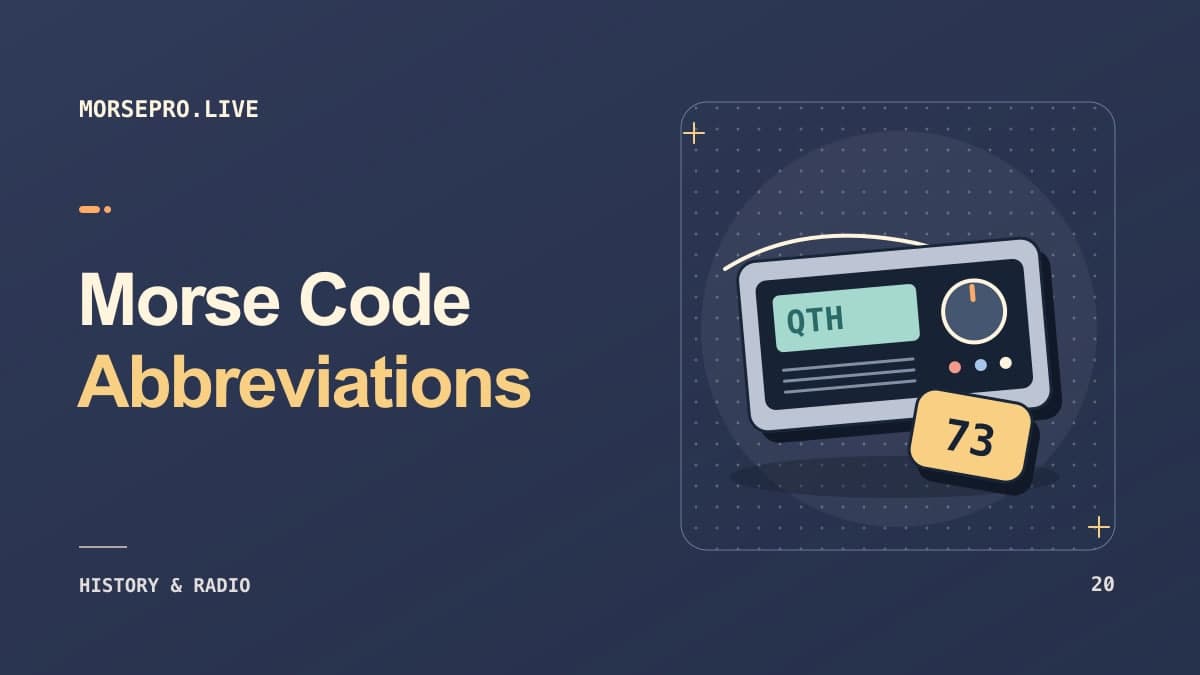
| 73 | Best regards | Closing an exchange |
| 88 | Love and kisses | Personal sign-off in some contexts |
The exact meaning can depend on operating context. HI HI, for example, is often used to convey laughter during a Morse contact. You would not interpret that as a conventional literal greeting if the operator had just told a joke. The standardized letter signals are unchanged; only the conversational convention differs.
New listeners should learn the most common abbreviations before memorizing dozens of rare ones. CQ, DE, R, TU and 73 appear often enough in typical examples that understanding them immediately makes practice recordings easier to follow. Longer lists can wait until you can recognize their individual letters by ear.
What Are Morse Code Prosigns?
Prosigns are procedural signals rather than ordinary vocabulary words. Their run-together timing is important. AR marks the end of a message, SK indicates the end of a contact, and AS commonly asks the listener to wait. An error or correction signal may be used when an operator has sent something incorrectly and needs to restart part of the transmission.
The distinction between run-together prosigns and spaced abbreviations is not merely typographical. A pair of letters sent without the normal gap can form a distinctive rhythm that operators learn as one procedural unit. When representing such signals in a web article, labels such as <AR> or <SK> help readers distinguish them from the ordinary letters A-R or S-K.
The ARRL Morse learning resource lists common special characters and prosigns, including their spoken rhythms. Use a recognized radio reference before assuming a pair of letters has a standard procedural meaning. Informal groups may create their own shorthand, but those local habits should not be presented as universal conventions.
Ham Radio Q Codes: QTH, QSL, QRS and More
Q signals are standardized three-letter groups used in radio communications. Many become questions when followed by a question mark and statements when sent without one, although the full conventions depend on the particular code. QTH concerns location, QSL concerns acknowledgment of receipt and QRS asks for slower sending.
| Q code | Practical meaning in context |
|---|---|
| QTH | Location; QTH? asks for location |
| QSL | Acknowledgment of receipt; QSL? requests confirmation |
| QRS | Send more slowly |
| QRQ | Send faster |
| QRM | Interference from other stations |
| QRN | Static or atmospheric noise |
| QRP | Reduce power / low-power operating context |
| QSY | Change frequency |
| QRZ | Who is calling me? |
| QRT | Stop sending / close station operations |
Q codes are concise because three letters can replace a longer question or instruction. That efficiency matters when sending every character through timed key presses. However, overusing Q codes in ordinary conversation can make communication less clear, especially for beginners. Learn what the other operator is likely to understand and use common conventions appropriately.
The ARRL operating aids provide an authoritative reference for many common Q signals. In voice conversations, operators often speak the intended meaning directly rather than reciting Q codes indiscriminately. The radio operating situation should guide the choice.
What Does 73 Mean in Morse Code?
73 is a customary amateur-radio closing meaning best regards. It is not an ordinary word and should not be confused with an arithmetic statement. If sent literally as Morse digits, 7 is --... and 3 is ...--, so the written code is --... ...-- with the proper gap between the numbers.
You may also encounter 88 as a friendly sign-off in some contexts, traditionally interpreted as love and kisses. These are conventions developed in telecommunications culture rather than direct translations of full English sentences. Their social meaning depends on who is sending them and how the exchange is framed.
A useful exercise is to compare the literal text "BEST REGARDS" with "73" in the Morse Code Translator. Both can convey a friendly ending to the right audience, but the longer phrase requires more transmitted characters. This demonstrates why shorthand gained a role in manual telegraph and radio traffic.
Example: What Does a Basic CW Contact Look Like?
A simple teaching example might begin CQ CQ CQ DE [CALL SIGN] K. CQ calls any listening station, DE identifies the sender, and K invites a reply. The bracketed call sign is a placeholder for the operator's actual authorized station identifier, not a pattern that should be transmitted literally. The next station replies using its own call sign and the conversation proceeds.
After contact is made, operators may exchange signal reports, names or locations, sometimes using QTH to refer to location. They might acknowledge information with R or QSL, say TU for thanks and finish with 73. A final SK prosign indicates that the contact has ended. This is a simplified educational example, not a substitute for national amateur-radio operating rules.
If you plan to transmit on actual amateur bands, learn the local licensing and station-identification requirements. A Morse web application can teach sounds and timing but does not supply legal operating privileges or radio-frequency equipment.
How to Practice Q Codes and Prosigns by Ear
Begin with ordinary letter abbreviations because their spacing follows normal Morse. Practice CQ (-.-. --.-) and TU (- ..-) as recognizable sound groups. Once you can hear them accurately, learn how proper prosigns differ in timing and procedural meaning. Avoid treating a prosign as ordinary spaced letters simply because its written label has two characters.
Use the Morse Code Practice page for recognition and the Morse Code Keyer for sending. The Morse Code Audio Decoder can help inspect a clean recorded signal, although actual radio noise and irregular timing may complicate automatic decoding.
When researching unusual codes, check reputable operating manuals rather than social media lists. Some shorthand varies across regions or operating groups, and a term may have more than one interpretation. Context remains part of the message.
Frequently Asked Questions
What does CQ mean in Morse code?
CQ is a general call inviting contact from any station listening on the frequency.
What does DE mean in CW?
DE introduces the station that is sending, commonly understood as "from" or "this is."
What does QTH mean?
QTH refers to location. In question form it asks for the other station's location.
What does QSL mean?
It concerns acknowledgment of receiving information; QSL? asks whether receipt can be confirmed.
Is 73 a special Morse character?
No. It is the digits 7 and 3 used as a conventional best-regards sign-off.
What is the difference between a prosign and an abbreviation?
A prosign is a procedural signal often sent run together; an abbreviation is usually ordinary letters sent with normal spacing.
Check any unfamiliar CW phrase with the MorsePro.live alphabet and translator before practicing the full message.