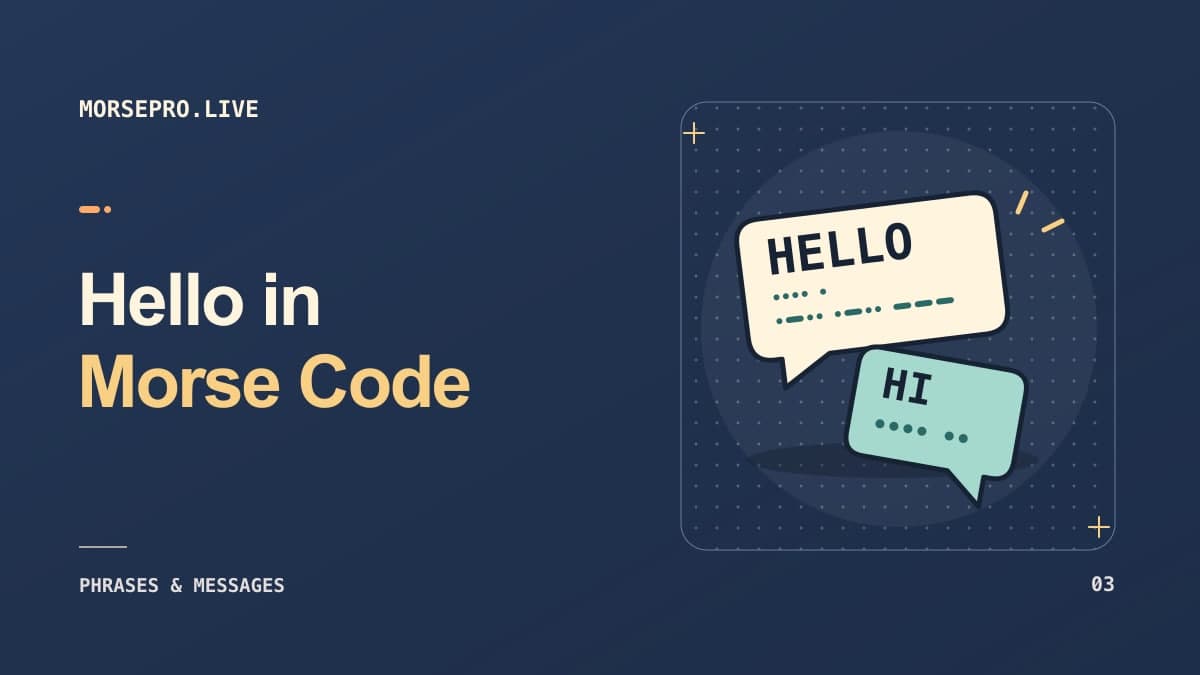
Quick answer: HELLO in Morse code is .... . .-.. .-.. ---. HI is .... ... Each space in the written patterns separates a letter; when transmitted by sound or light, that separation becomes a longer pause than the gaps between marks inside a single letter.
A greeting is a friendly first exercise in Morse. It is easy to imagine using a flashlight, a buzzer or a written note to say hello, and a five-letter word contains several useful sound shapes. HELLO includes a four-dot H, the simple single-dot E, two copies of L, and three long dashes for O. Learn those sounds, and you have already met four members of the Morse alphabet.
Hello in Morse Code: Exact Dots and Dashes
The full pattern is .... . .-.. .-.. ---. Here is its construction:
| Letter | Morse code | Recognition tip |
|---|---|---|
| H | .... | Four quick dots |
| E | . | One short signal |
| L | .-.. | Dot, dash, dot, dot |
| L | .-.. | Repeat the same rhythm |
| O | --- | Three long dashes |
The two L letters must stay separate. Combining them would make one long, ambiguous string. This is especially important when HELLO becomes a bead design or is engraved in a font with minimal spacing. A good written example leaves the smallest gaps inside letter patterns, larger spaces between letters and a word separator only when another word follows.
You can copy HELLO directly or type an entire greeting into the text-to-Morse translator. The tool can create patterns for phrases such as "Hello Emma," "Hello world" or "Hello from home," so you do not need to memorize every character before composing a message.
Hi in Morse Code: The Shorter Greeting
HI in Morse code is .... .., four dots for H followed by two for I. There are no dashes in this everyday two-letter word. The letter boundary still matters: if all six dots run together, the receiver could interpret the series in more than one way. Write a visible space between the four-dot and two-dot groups and make a distinct pause when signaling.
Which greeting should you choose? HELLO sounds more complete and demonstrates both short and long marks. HI is quick, approachable and ideal for testing a new Morse keyer. For beginners, HI can also create a useful listening drill: play H alone, I alone and then the pair, noticing the silence that separates them.
A small contextual note: amateur-radio operators sometimes use "HI" or "HI HI" in CW contacts to indicate laughter rather than to say hello. That is a convention of radio shorthand, not a change in the underlying encoding. Context determines whether a plain greeting or the operator's conversational abbreviation is intended.
How to Say Hello in Morse Code with Beeps
A dot is a short sound and a dash is a longer sound, usually three times a dot's duration. Listen to H as four short beats, E as a single beat, L as short-long-short-short, and O as long-long-long. Keep the audio volume comfortable and listen for the spaces as actively as you listen for the notes.
A practical learning sequence is to play one letter at a time, then the word at a slow overall speed, then the same word with slightly faster characters. Do not obsess over counting elements forever. As you improve, each letter begins to sound like a recognizable rhythm. The Morse Code Practice page is designed for exactly that kind of listening exercise.
If you want to send the greeting as audio in a message, enter it in the Morse Code Generator and choose the appropriate sound export. Before sharing a file, play it once and confirm that the pauses are audible. A recording with clipped notes or no silence between letters may be harder to decode than a simple clean beep.
Send Hello with a Flashlight or by Tapping
For light signaling, switch on briefly for each dot and hold the light longer for each dash. HELLO is not a distress call, so do not use it where an observer might mistake unusual flashing for an emergency signal. Practice in a controlled environment with someone who already knows the code or has a reference chart.
For a tabletop game, tap the dot patterns quickly and make each dash a longer press or knock. HELLO is useful because it starts with H, which challenges you to keep four short marks distinct, and ends with O, which challenges you to make three long marks equal. After the word is recognizable, try spelling the listener's name.
The Morse Code Keyer gives you a straightforward way to practice press-and-release rhythm. It is usually easier to learn one form of signaling well before switching between hand taps, flashlights and buzzers, especially when letter spacing is new.
Hello World in Morse Code and Other Common Greetings
HELLO WORLD is .... . .-.. .-.. --- / .-- --- .-. .-.. -... The slash is a readable substitute for the longer pause between words. Software developers often start programs with "Hello World," which makes this a natural first phrase for experimenting with encoding and decoding.
Another common greeting is GOOD MORNING. Its complete pattern is longer, so it makes better practice after you know how to separate words reliably. GOOD NIGHT is a friendly ending for a coded note. HEY and HI are shorter alternatives, but each must be translated from its own letters; they do not share a universal greeting signal.
In amateur radio, operators frequently abbreviate greetings as GM for good morning, GA for good afternoon or GE for good evening. These abbreviations are ordinary letters transmitted in Morse, not special alphabet characters. For your own messages, full words are often easier for a beginner to understand unless you agree on shorthand first.
Why Hello Morse Code Sometimes Decodes Incorrectly
The most frequent cause is missing separators. A string such as .... .. clearly gives HI to a decoder using spaces as letter boundaries, while ...... is ambiguous. Similarly, HELLO loses its recognizable structure if the two L patterns are joined. If you receive a recording, pay attention to silence lengths; if you receive printed code, look for readable spaces.
A second cause is confusing letters that share the same marks in different orders. A is dot-dash, N is dash-dot, and L contains both plus two extra dots. Use the Morse alphabet chart whenever you're unsure. For text that has already arrived as dots and dashes, paste it into the Morse-to-Text Translator rather than guessing.
A third cause is assuming printed punctuation always acts as a separator. A slash placed between encoded words is a formatting convention, but a literal slash character also has its own International Morse pattern. The meaning depends on whether the slash is part of the readable notation or the message itself.
A Five-Minute Hello Morse Code Practice Routine
Choose HELLO and HI as your two exercises. During the first minute, review H, E, L, O and I on an alphabet chart. During the second, play HELLO while following the written groups with your finger. Next, listen to HI without looking; identify where H ends and I begins. Spend a fourth minute tapping the letters slowly, and finish by typing the message into a decoder to verify what you sent.
Repeat the routine on another day with slightly less visual help. If you consistently confuse the repeated L patterns in HELLO, isolate L before replaying the full word. If HI sounds like one continuous series of six dots, pay particular attention to the letter gap. This small exercise works for learners without turning a friendly greeting into a formal radio lesson.
Frequently Asked Questions
What is hello in Morse code?
HELLO is .... . .-.. .-.. --- in International Morse code. Keep one readable space between each letter pattern.
What is hi in Morse code?
HI is .... ..: four dots for H and two dots for I. It is shorter than the full HELLO greeting.
Does Morse code have capital letters?
No. Morse identifies character patterns without distinguishing uppercase from lowercase letters, so Hello and HELLO are sent identically.
Can I hear hello in Morse code?
Yes. Enter HELLO in a translator with audio playback or use the sound generator to listen at different speeds.
What does HI HI mean on amateur radio?
In CW conversations, HI HI is often shorthand for laughter. That operator convention differs from the simple English greeting HI.
Can I send hello with a phone flashlight?
A controllable light can represent the pattern, but exact capabilities depend on your device. Ensure short and long flashes remain visually distinct and practice safely.
To personalize the greeting, convert your text on MorsePro.live and listen to the result.